
Updated October 18, 2026. This guide combines manufacturer manuals and diagnostic guidance. The current-draw figures and battery calculations below are illustrative examples, not measurements of a particular charger or motorcycle.
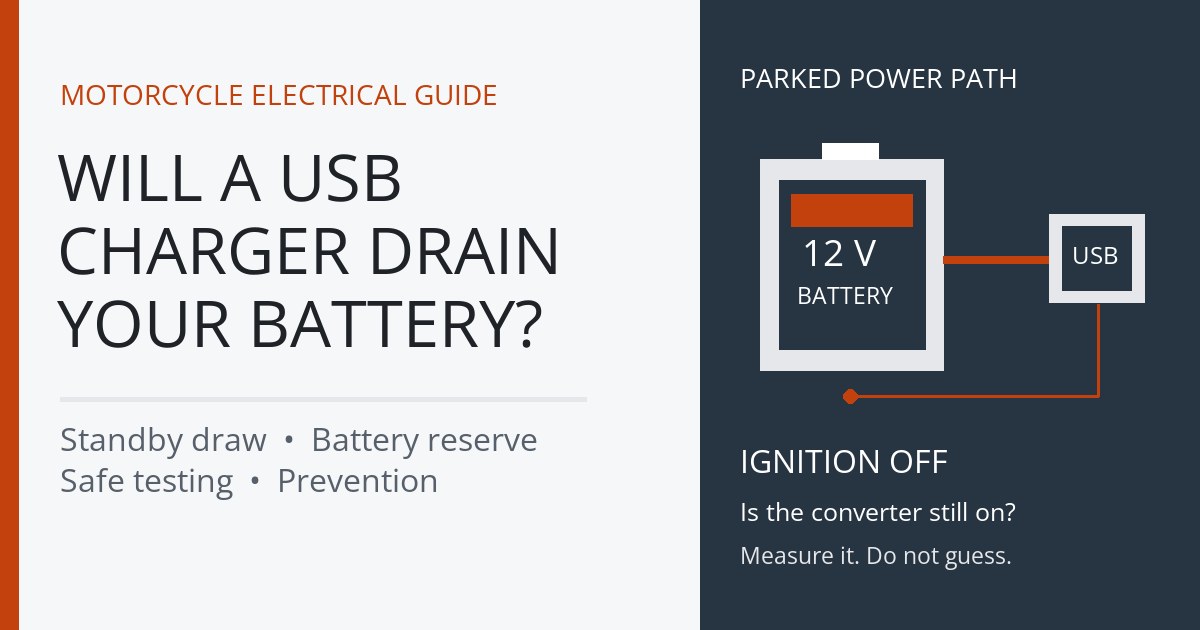
Short answer: yes, a motorcycle USB charger can drain the battery while the engine is off. If the socket is always live, its internal electronics may consume standby current even with nothing plugged in. Leaving a phone charging overnight is a much larger load. An ignition-switched socket normally avoids parked drain; a properly designed automatic-cutoff charger can also help, provided its cutoff suits the bike’s battery.
The important question is not whether the charger has a USB-C port or a waterproof cap. It is where it gets power, what it draws when parked, and when that power stops. This guide explains how to check each factor without relying on myths about “zero-draw” adapters.
Editorial disclosure: This is a research-based technical guide; we have not measured an individual motorcycle’s current draw. HandlebarHQ may earn commissions on other product pages. See our affiliate disclosure and editorial policy.
Why a USB charger can flatten a parked motorcycle battery
A USB converter attached to the positive battery terminal receives 12 V power continuously unless a switch, relay or control circuit disconnects it. Depending on its design it may keep a power indicator, voltage monitor, Bluetooth controller or DC-DC circuitry active. Even a small current can accumulate over days or weeks on a small motorcycle starter battery. Other vehicle loads, like clocks, alarms and immobilizers, can be present at the same time.
The charger might also keep a connected phone charging after the bike is turned off. This makes the difference between a few milliamps of standby draw and a much higher input current powering the phone. A charging socket that looks “off” is not proof that it draws no current: check the product documentation or measure it.
Three wiring arrangements and their battery-drain risk
| Installation | When parked | Battery-drain risk |
|---|---|---|
| Ignition-switched OEM ACC/relay | Charger loses input power once the circuit switches off | Lowest if wiring and shutoff are correct |
| Fused always-live battery/SAE adapter | Converter stays connected; phone may also continue charging | Depends on standby draw and whether the phone remains connected |
| Battery-connected smart adapter with automatic cutoff | Voltage or time-based controller interrupts USB output | Lower when functioning correctly, but not necessarily zero standby draw |
For installing a new power outlet, our How to Install a Motorcycle USB Charger Safely guide explains the OEM accessory circuit, fuse placement and relay power path. For an everyday charging overview, see How to Charge Your Phone on a Motorcycle.
How much battery capacity does a charger use?
The current drawn from the motorcycle battery, not a USB output rating, is the number you need for a parked-battery calculation. If the bike is off and input draw is approximately steady, the arithmetic is straightforward:
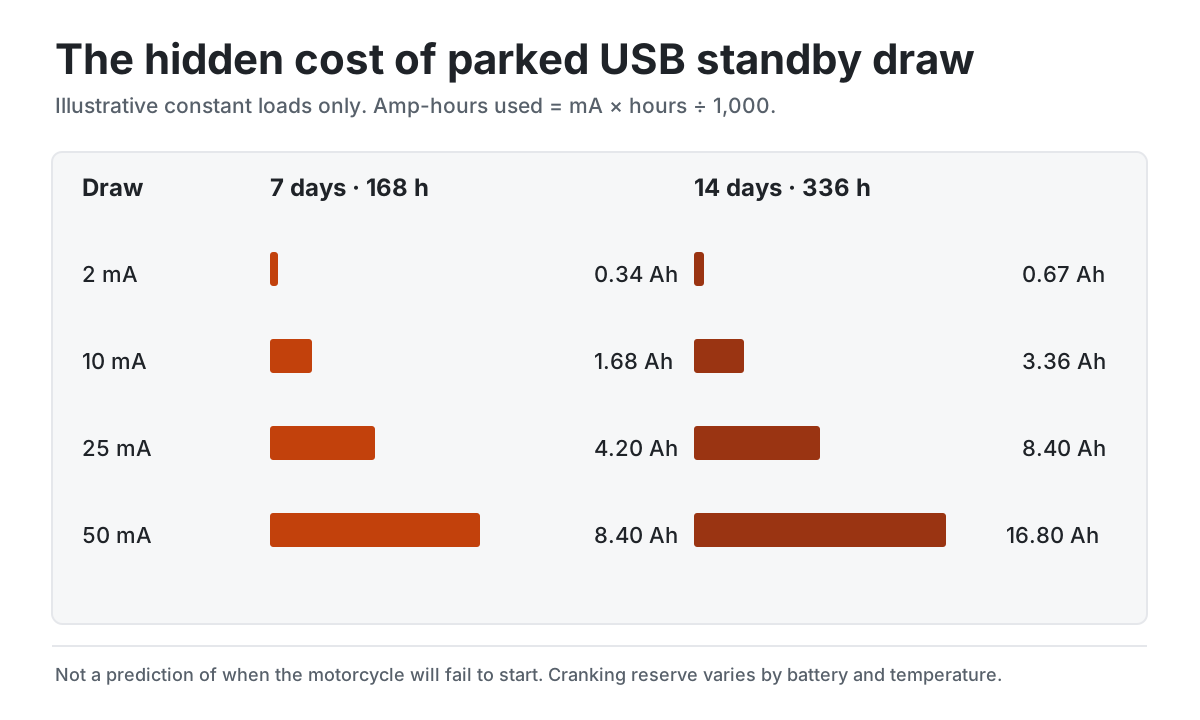
Amp-hours used (Ah) = input draw (mA) × parked hours ÷ 1,000. This counts a constant electrical load only. It excludes self-discharge, battery condition, cold cranking requirements, changes in voltage and other electronics.
Illustrative parasitic-drain table (charger-only)
| Constant parked draw | 7 days (168 h) | 14 days (336 h) |
|---|---|---|
| 2 mA | 0.34 Ah | 0.67 Ah |
| 10 mA | 1.68 Ah | 3.36 Ah |
| 25 mA | 4.20 Ah | 8.40 Ah |
| 50 mA | 8.40 Ah | 16.80 Ah |
These are mathematical examples, not tested standby currents for any product. If a calculated amp-hour loss exceeds the battery’s available capacity, the battery cannot continue delivering that constant current for the full period; the simple arithmetic is no longer physically achievable. They illustrate why even 10 mA matters over a fortnight. A motorcycle may fail to crank long before its labeled capacity has been removed. A nominal 8 Ah starter battery is not an 8 Ah power bank that you should use to zero. Starting demands reserve and high current; age and temperature alter the outcome.
Example with a connected phone: Suppose USB charging delivers 10 W and the converter is 80% efficient. The motorcycle battery must supply about 12.5 W. At an illustrative battery voltage of 12.5 V, that is roughly 1 A of battery-side draw; two parked hours could take about 2 Ah. Actual USB power, converter efficiency and battery voltage vary. This example is not a measured phone-charger test.
Will the charger drain a motorcycle battery overnight?
It depends on the total parked current, phone load and battery reserve. A few milliamps of standby draw alone might not create an obvious overnight problem on a healthy, fully charged battery, but leaving a phone charging for hours is a different scenario. An older, partially discharged or undersized battery can fail much sooner, especially in cold weather. If the bike is repeatedly weak after short stops, diagnose charging-system health and total parasitic draw rather than blaming the USB outlet immediately.
Quad Lock: why the exact charger model matters
Quad Lock’s 12–24 V hardwired waterproof wireless charging head requires ignition-positive wiring or an isolator and specifies a 3 A inline fuse. Its support documentation explicitly warns that connecting this head to steady battery positive can drain the battery.
But Quad Lock also sells a different Waterproof 12 V-to-USB Smart Adaptor with ON, OFF and AUTO. Quad Lock says AUTO activates above 13.5 V and turns off below 12.5 V. On some lead-acid or AGM batteries, the shutdown may take 10–15 minutes after parking as voltage settles; that delay alone is not a failure.
Important lithium caveat: Quad Lock says the Smart Adaptor’s AUTO mode can remain on with lithium motorcycle batteries because their resting voltage may stay above its cutoff threshold. On a lithium-equipped bike, Quad Lock recommends manual ON/OFF rather than relying on AUTO. Do not assume “auto” means a reliable ignition detector for every battery chemistry.
OptiMate: an example of battery-protected USB charging
OptiMate describes USB chargers that can stay connected to a motorcycle battery and switch USB charging into standby after the vehicle has been parked, with an additional low-voltage shutoff. For its USB range, OptiMate documents standby about one hour after engine-off and shutoff when battery voltage is low. Its O-118PD is a 20 W USB-C model intended for permanent fused battery connection with voltage sensing.
That is a documented product-specific feature, not permission to leave any generic motorcycle USB adapter connected indefinitely. Confirm whether the particular model you own actually disconnects USB output, whether its standby draw is published, and whether it supports the bike’s battery type.
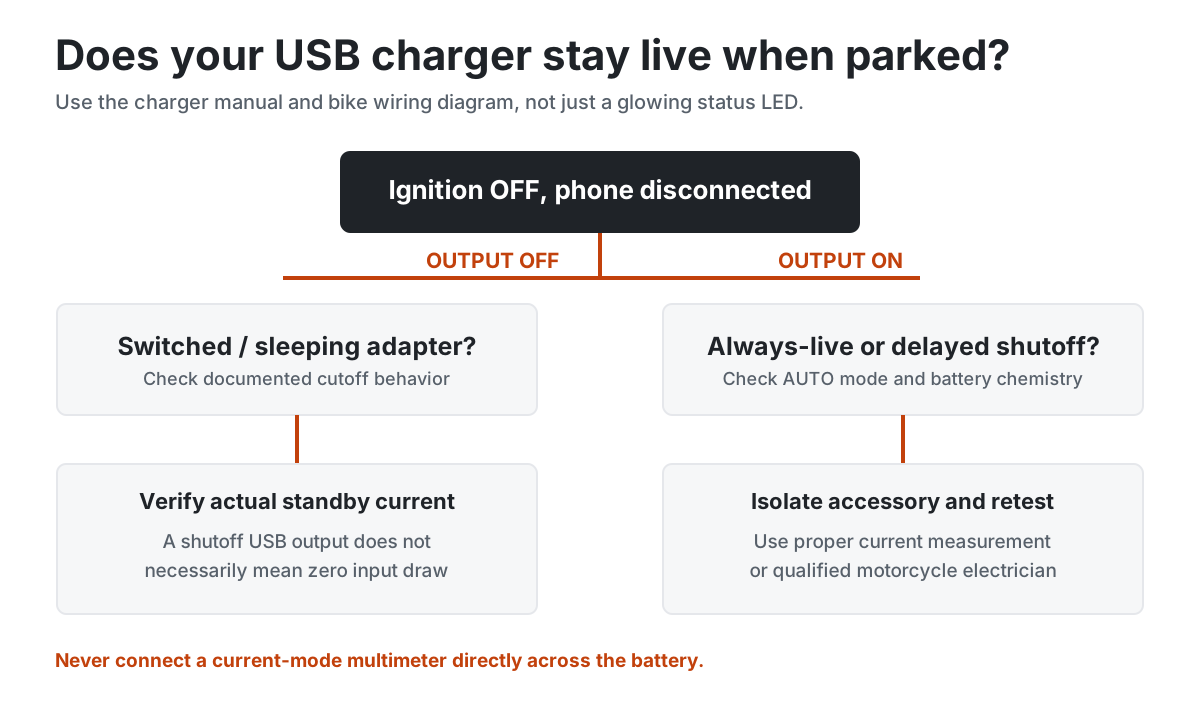
How to find out whether your USB charger is the problem
1. Check the installation and behavior first
- Read the charger manual: is the lead intended for constant battery power, an ACC outlet, or a protected smart adapter?
- With the ignition off, disconnect the phone, wait for delayed-accessory circuits to sleep and observe whether the outlet remains powered.
- If it has an ON/OFF/AUTO switch, verify the selected setting and the documented cutoff timing.
- Consider other added loads: alarm, tracker, heated-grip controller, dashcam parking mode, and hardwired CarPlay screens.
2. Measure parked current safely
A vehicle’s parasitic draw is measured in amps, not by putting a meter on DC volts across the battery terminals. A multimeter set to current mode effectively creates a low-resistance path; never connect a current-mode meter directly across the battery, never crank the engine through a meter and never exceed the meter’s fused input limits.
Fluke’s diagnostic method uses a suitably rated current meter in series with the battery circuit after the vehicle is off and control modules have gone to sleep. Fluke advises beginning on the appropriate high-current input range and using the correct leads and terminals. An appropriate low-current DC clamp meter or professional parasitic-draw tester may avoid interrupting vehicle power, but not every ordinary clamp meter can resolve milliamp currents.
On a motorcycle with complex electronic modules, battery management or an uncertain procedure, use a qualified technician. Disconnecting power can reset some systems or wake up modules and distort readings. Do not borrow “normal 50–85 mA” thresholds from car articles: a particular motorcycle can have substantially different acceptable standby current and a much smaller starting battery. Compare against the bike’s service data or a known baseline.
3. Compare readings with the charger isolated
After the bike has entered its normal sleep state, a technician can compare total draw with the USB accessory circuit connected versus properly isolated. If the draw falls materially when that accessory is removed, the charger or connected wiring is contributing. A decrease does not automatically mean the charger is defective: some always-live modules are designed to draw a small amount. The real question is whether the total load is compatible with your battery and parking habits.
4. Test battery and charging-system health
If the bike loses charge even after the charger is disconnected, investigate battery condition, self-discharge, other accessory loads and the charging system. Resting voltage by itself cannot reliably measure available cranking capacity, particularly on lithium batteries. Use chemistry-specific test procedures, and do not assume a brief idle will fully recharge a deeply discharged starter battery.
How to prevent battery drain from motorcycle USB chargers
Choosing a charging outlet? Compare our best motorcycle USB-C chargers, including the difference between genuine 20 W Power Delivery and fixed 5 V USB-C.
Before choosing the power feed, read our Motorcycle CarPlay installation: ACC vs battery vs USB guide for manufacturer-specific CHIGEE, Carpuride and Aoocci requirements, safe fuse selection and key-off troubleshooting.
Considering recording while the motorcycle is parked? Our dashcam parking mode and battery-drain guide explains supported modes, K7-specific power wiring and starter-battery protection.
- Use a documented switched OEM accessory circuit. If capacity is sufficient, the charger will stop drawing power when that circuit switches off.
- Use a fused, ignition-triggered relay or controlled power distribution unit. Follow your motorcycle’s wiring diagram and avoid splicing safety-critical wiring.
- Choose a battery-direct adapter with genuine cutoff logic. Verify voltage thresholds, delay and battery-chemistry compatibility.
- Unplug the phone and switch off the adapter after stopping. Simple but important on always-live sockets.
- Use the right maintenance charger during storage. Match the tender to lead-acid/AGM or LiFePO4 as appropriate; follow the battery manufacturer’s instructions.
- Measure the bike’s total parked draw. A tracker, alarm or other accessory may dominate USB standby current.
What about lithium (LiFePO4) motorcycle batteries?
LiFePO4 motorcycle starter batteries can rest at a higher voltage than lead-acid, so some automatic adapters that infer “engine running” from a voltage threshold may not turn off as expected. A lithium battery with a built-in battery management system (BMS) may provide a low-voltage cutoff, but not every model has the same protection, and a BMS trip can still leave you unable to start until the manufacturer’s restart or recharge procedure is followed.
Do not reuse a lead-acid voltage-versus-charge chart for a lithium starter battery. The safest control strategy is still a documented ignition-switched supply or a cutoff confirmed compatible with the battery. Match maintenance chargers and jump-start practices to the battery manufacturer’s manual.
Battery keeps dying after a few days: quick diagnostic checklist
- Check whether the USB converter is wired to constant battery positive or ignition-switched ACC.
- Remove the phone and any other accessory load before evaluating standby draw.
- Wait for the bike’s normal delayed-shutdown/sleep interval.
- Confirm correct AUTO/OFF state on any smart adapter, particularly with lithium batteries.
- Have total parasitic current measured with the correct instrument and method.
- Repeat the measurement with the USB circuit isolated to identify its share of the load.
- Test battery health and the charging system if the problem remains.
Frequently asked questions
Does a USB charger drain a motorcycle battery if nothing is plugged in?
It can. Some converters and indicators continue to draw standby current as long as their battery feed is live. Others disconnect or enter low-power standby. Check the exact charger model and, if necessary, measure battery-side current.
Can I leave a USB-C outlet connected to the motorcycle battery?
Only if the product is designed for that arrangement and it is correctly fused and protected. An automatic low-voltage or time cutoff is preferable; otherwise use switched power or disconnect the adapter before longer parking periods.
How many days until a motorcycle battery dies from a USB charger?
There is no responsible universal number. It depends on parked milliamps, hours parked, the battery’s actual state, other vehicle loads and cranking reserve. The comparison table above gives amp-hour arithmetic without claiming a guaranteed no-start date.
Does the battery drain with the ignition off but the USB LED on?
An illuminated indicator proves that the accessory is receiving power and consumes some power itself, but the total parked current may be much larger or smaller than you assume. Measure or obtain reliable manufacturer standby specifications.
Will Quad Lock wireless charging drain my motorcycle battery?
Its hardwired 12–24 V waterproof wireless charging head can drain a battery if wired to steady positive; Quad Lock requires ignition-positive wiring or an isolator. The separate voltage-sensing Smart Adaptor has an AUTO mode, but Quad Lock warns it may remain on with lithium starter batteries.
Can I use a battery tender to compensate for an always-live USB charger?
A suitable maintenance charger may offset small drains during proper storage, but it is not a substitute for correcting unsafe wiring or an unexpectedly high parasitic draw. Use the correct maintenance device for the battery chemistry and follow the tender’s instructions.
Sources and editorial method
We checked Quad Lock’s hardwired charger guidance, its smart adapter lithium and AUTO caveats, OptiMate USB battery protection, the O-118PD specification, and Fluke’s parasitic-draw testing safety. Figures in the amp-hour table are calculations, not product test results. We have not performed physical testing on a particular motorcycle.