
Last updated October 17, 2026. Prices and availability were checked against current manufacturer and Amazon listings. This guide is based on manufacturer documentation, current retail listings and owner/reviewer evidence. No hands-on testing is claimed.
The best motorcycle TPMS should do one thing reliably: warn you about a pressure problem early enough to react before a soft tire becomes a handling problem. The right system depends less on flashy app features than on sensor type, valve-stem compatibility and how you want to see the warning.
Our overall pick is the Chigee G3 because it gives you a dedicated display, external or internal sensor options, IP67 weather protection and a current price of about $109.99. If you prefer phone-based monitoring, FOBO Bike 2 is the stronger app-first choice. For value, the Sykik SRTP300 is hard to beat around $55–$58 – but only if your motorcycle has suitable metal valve stems.
Quick picks
- Best overall: Chigee G3 – standalone display, external or internal sensors, IP67 protection and a five-month quoted display battery life.
- Best app-based TPMS: FOBO Bike 2 – Bluetooth 5.0, iOS/Android monitoring and real-time pressure/temperature alerts.
- Best value dedicated display: Sykik SRTP300 – small standalone monitor, replaceable sensor batteries and current Amazon pricing around $55.95.
- Best internal-sensor value: Sykik SRTP400 – internal metal-stem sensors, 0–99 PSI range and no phone required.
- Best multi-tire app system: TireMinder Motorcycle TPMS – monitors up to four tire positions from 0–80 PSI through its phone app.
Affiliate disclosure: This page contains affiliate links. If you buy through them I may earn a commission at no cost to you. How HandlebarHQ earns money.
Motorcycle TPMS comparison
| Pick | Sensor type | Display | Current price* | Best for |
|---|---|---|---|---|
| Chigee G3 | External or internal | Dedicated display | $109.99 | Best all-round standalone system |
| FOBO Bike 2 | External | Phone / app | $99 | App-first monitoring |
| Sykik SRTP300 | External | 1.5-inch display | $55.95 Amazon | Value + dedicated display |
| Sykik SRTP400 | Internal | 1.5-inch display | $69.95 direct | Rubber-stem / internal-sensor setups |
| TireMinder Motorcycle TPMS | External | Phone / app | $129 direct | Up to four tire positions |
*Prices checked October 17, 2026. Retail pricing changes frequently; use the live links before buying.
The most important buying decision: external vs internal sensors
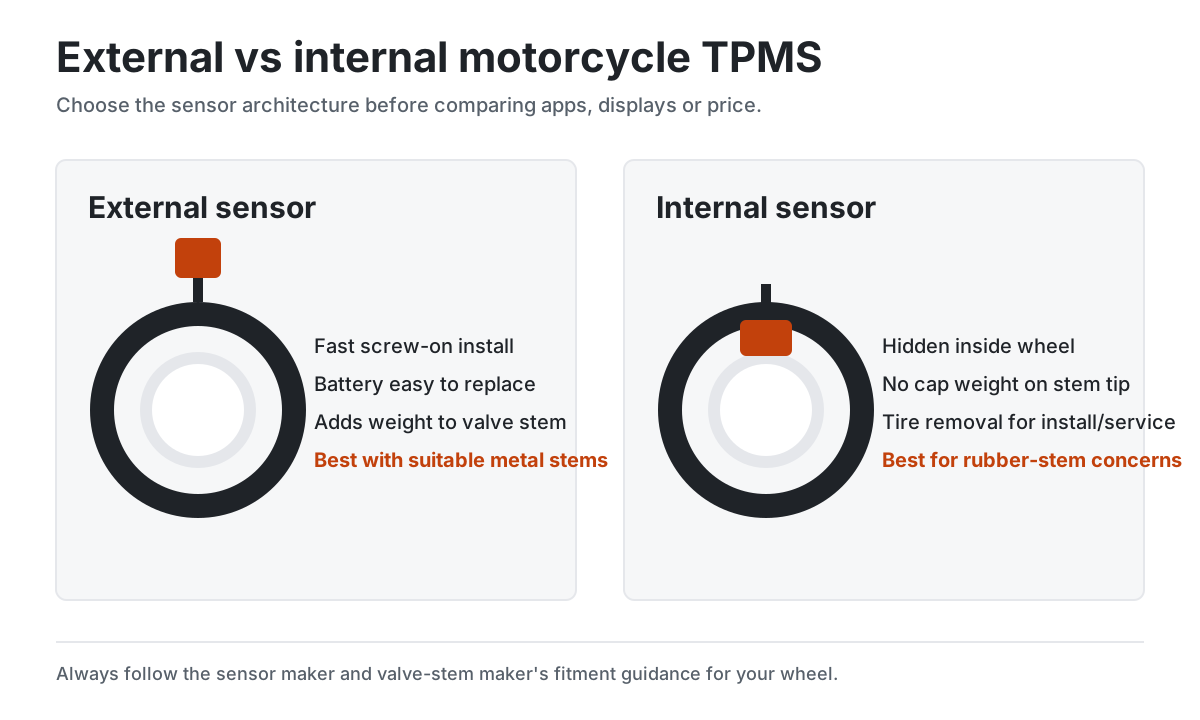
Before comparing apps or screen brightness, look at your valve stems. External TPMS sensors screw onto the valve like oversized caps. That makes installation easy and lets you replace batteries without removing the tire, but the sensor adds mass and bending load to the valve stem.
This matters on motorcycles with flexible rubber valve stems. FOBO’s Bike 2 manual strongly recommends using its sensors only with metal valves because the condition of rubber valves is difficult to judge. Sykik is even more explicit: its SRTP300 external sensors are designed for metal valve stems and the company warns that rubber stems may rupture under pressure/load from an external sensor.
If your bike has rubber stems, do not assume an external cap sensor is automatically safe because it physically screws on. Either replace the stems with suitable metal valves or choose an internal system such as Sykik SRTP400 or the internal-sensor version of Chigee G3.
1. Chigee G3 – best motorcycle TPMS overall
The Chigee G3 is the strongest all-rounder because it avoids the biggest compromise of app-only systems: you do not need your phone to see tire pressure. The compact dedicated display wakes with vibration, shows pressure and temperature, has three brightness levels and is rated IP67 for permanent motorcycle use.
Chigee currently sells the G3 for about $109.99 and includes two sensors. You can choose external or internal sensors when ordering, which makes it much easier to match the system to your wheels and valve stems rather than forcing one sensor style onto every bike.
The display uses magnetic charging and Chigee quotes roughly five months of battery life. The company states pressure accuracy within 0.01 bar. Its 1/4-inch mounting thread is also useful because you are not locked into one proprietary handlebar bracket.
Owner feedback on Chigee’s own store is generally positive about pressure accuracy, build quality and readability. The recurring negatives are less serious but worth noting: some riders find the setup instructions vague, a few complain that temperature readings are less useful than pressure, and one owner reported the dark display housing getting very hot in direct sunlight.
Buy it if: you want a clean standalone display and the flexibility to choose internal or external sensors. Avoid it if: you specifically want alerts integrated into your phone/watch rather than another cockpit display.
2. FOBO Bike 2 – best app-based motorcycle TPMS
FOBO Bike 2 is the better choice if you already ride with a phone mounted or keep audio notifications running through a Bluetooth headset. It uses Bluetooth 5.0 and monitors tire pressure and temperature through FOBO’s iOS/Android app rather than adding a dedicated screen to the handlebars.
The current Amazon price is about $99. The appeal is a very clean installation: screw on the paired sensors, set your pressure limits in the app and let the phone handle the display and alerts.
The trade-off is dependence on another device. If your phone battery is low, the app is closed, permissions break after an OS update or you simply do not want a phone visible while riding, a dedicated-display TPMS is less fragile operationally.
FOBO’s own Bike 2 manual also contains the most important fitment warning in this guide: the company strongly recommends metal valve stems for the external sensors. Treat that as a requirement unless your valve manufacturer explicitly supports the added sensor mass.
If you already use your phone as part of the cockpit, see Best Motorcycle Phone Mounts for the mounting side of the setup.
3. Sykik SRTP300 – best value with a dedicated display
The Sykik SRTP300 is the easy value recommendation. Amazon currently lists it around $55.95, yet it gives you a separate 1.5-inch display, real-time pressure and temperature, audible/visual leak alerts, separate front/rear threshold settings and replaceable CR1225 sensor batteries.
The monitor is rechargeable and Sykik quotes roughly six to nine months between charges depending on use. The sensors sleep when the motorcycle is stationary and wake with movement, which helps extend battery life.
Sykik uses radio rather than Bluetooth between the sensors and head unit, so the SRTP300 does not work with a phone app. That is a benefit if you want a self-contained system and a drawback if you expected phone notifications.
The limitation is valve-stem compatibility. Sykik says the external sensors are intended for metal valve stems and explicitly warns against flexible rubber stems. If your bike has rubber valves, move to an internal system instead of trying to save $15.
Buy it if: you want the cheapest proven dedicated-display system here and already have metal stems. Avoid it if: you have rubber valve stems or want phone-based alerts.
4. Sykik SRTP400 – best internal-sensor value
The SRTP400 takes the opposite approach: the sensors sit inside the wheel and replace the valve stems. That removes the external cap weight, keeps the sensor protected and is the better answer for riders who do not want external sensors loading flexible valve stems.
Sykik currently lists the SRTP400 from about $69.95. The system reads 0–99 PSI, displays pressure and temperature on its rechargeable 1.5-inch monitor and uses metal valve stems. Sykik says the internal sensor batteries typically last multiple years.
The obvious cost is installation. You need the tire off the rim to fit or replace an internal sensor, so this option makes the most sense when you are already changing tires or having a shop service the wheels.
Check the stem-hole size before ordering. Sykik offers 8 mm and 11 mm-related variants/adapters depending on wheel fitment, and the manufacturer repeatedly tells buyers to verify rim dimensions rather than assume.
Buy it if: you want internal sensors, have rubber stems or are fitting new tires anyway. Avoid it if: you want a five-minute driveway installation.
5. TireMinder Motorcycle TPMS – best multi-tire app system
TireMinder’s motorcycle kit is another app-based system, but its differentiator is expansion. It can monitor up to four tire positions from 0–80 PSI through the TireMinder Cycle app, which makes it useful for trikes, motorcycles with a trailer or riders who want more than a basic two-sensor configuration.
The current direct price for the two-transmitter kit is about $129. Each external transmitter weighs about 0.3 oz and uses a replaceable CR1632 battery. The app shows pressure and temperature while stationary or moving, and TireMinder says it can request a fresh reading before the ride instead of making you roll the bike first.
Its 80 PSI ceiling is plenty for normal motorcycle applications but worth noticing if you intend to repurpose the system for something requiring higher pressure. As with other external valve-cap sensors, confirm your valve-stem suitability before fitting them.
Buy it if: you need up to four monitored positions or already use the TireMinder ecosystem. Avoid it if: you want a dedicated cockpit display.
Do you need TPMS on a motorcycle?
A TPMS is not a substitute for checking tires before a ride. What it adds is change detection while you are riding. A nail or valve leak does not always produce an obvious handling change immediately, especially on a loaded touring bike. A pressure alarm can give you earlier warning that something is changing.
That is particularly valuable on long motorway rides, touring bikes carrying luggage, commuting in debris-heavy urban traffic and motorcycles where the rear tire is difficult to inspect visually.
External vs internal TPMS sensors: which is better?
External sensors are cheaper, quicker to install and easier to service. You can change batteries in minutes. Their downsides are valve-stem loading, theft exposure and the need to remove the sensor whenever you add air.
Internal sensors are cleaner and do not hang weight off the end of the valve, but fitting them means breaking the tire bead/removing the tire. When the internal battery eventually dies, servicing is more involved.
For a motorcycle already equipped with sturdy metal stems, external sensors are usually the sensible retrofit. For rubber stems, new tires or a rider who wants a factory-like installation, internal sensors are the better long-term solution.
Phone app or dedicated TPMS display?
Phone-based systems keep the cockpit clean and can route warnings into a phone/watch/headset ecosystem. They also create more dependencies: Bluetooth, app permissions, phone battery and background-process behaviour.
A dedicated display does one job. It wakes with the motorcycle, stays visible even when the phone is in a pocket and does not care what Apple or Google changed in the latest OS update. For touring and daily commuting, we generally prefer a dedicated display unless the rider already uses the phone as the primary cockpit.
Can a CarPlay screen replace a standalone TPMS?
Sometimes. Several motorcycle CarPlay systems accept their own paired TPMS sensors and show pressure directly on the larger screen. That can be a cleaner solution than adding another display.
But the sensors are usually proprietary to that screen ecosystem. Chigee, for example, explicitly says the G3 sensors pair with the G3 display and are not the same sensors used to show tire pressure on Chigee’s larger displays.
If you are already shopping for an integrated cockpit system, see Best Motorcycle CarPlay With Dash Cam, where TPMS integration is part of the comparison.
How accurate does motorcycle TPMS need to be?
Use TPMS primarily to detect trends and abnormal changes, then confirm with a known-good handheld gauge when accuracy matters. Do not chase tenths of a PSI between different tools; sensors, ambient temperature and gauge calibration all create small differences.
The more important question is whether the system updates consistently and gives a clear alarm when pressure crosses the limits you set.
What pressure should you set the alarms to?
Start with the motorcycle manufacturer’s recommended cold tire pressures, not a generic TPMS default. Then set the low threshold far enough below normal pressure to avoid nuisance alarms but high enough to warn you before handling becomes noticeably poor.
Do not copy another rider’s thresholds just because they use the same TPMS. Motorcycle, tire construction, load and riding style can all change the correct cold pressure.
Best motorcycle TPMS by rider type
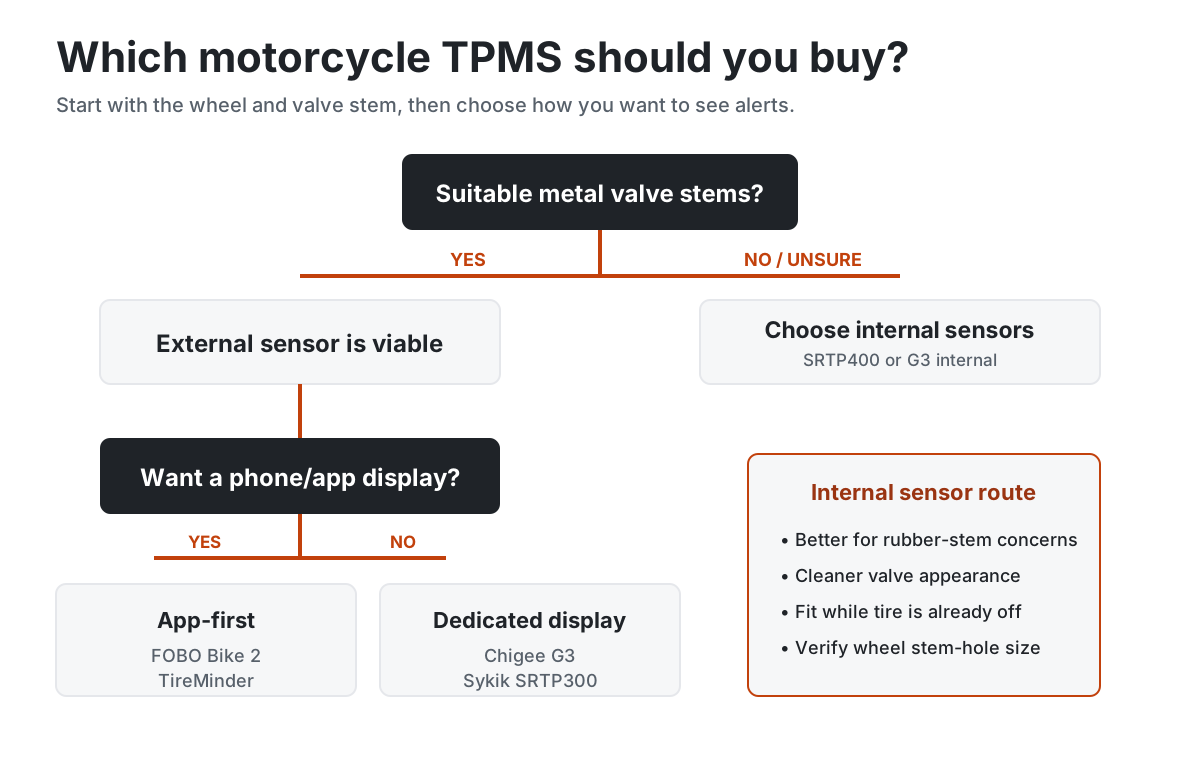
- Daily commuter: Sykik SRTP300 if you have metal stems; simple display, low cost.
- Tourer: Chigee G3; standalone display and internal/external sensor choice.
- Phone-first rider: FOBO Bike 2.
- Rubber-stem motorcycle: Sykik SRTP400 or Chigee G3 with internal sensors.
- Trike / more than two positions: TireMinder Motorcycle TPMS.
- Already using a compatible CarPlay display: investigate that display maker’s own TPMS sensors before adding a second screen.
Final verdict
The Chigee G3 is our best overall motorcycle TPMS for 2026 because it combines a dedicated, weatherproof display with the ability to choose external or internal sensors. At $109.99, it is not the cheapest, but it solves more fitment situations than the app-only alternatives.
Choose FOBO Bike 2 if you want the phone to be the display. Choose Sykik SRTP300 if value matters and your bike has metal stems. If you have rubber stems or are already changing tires, the SRTP400 is the safer architecture.
The one rule that matters more than our ranking: match the sensor to the valve stem before you buy. An inexpensive TPMS fitted correctly is more useful than a premium system installed on unsuitable hardware.
Frequently asked questions
What is the best motorcycle TPMS?
Our overall pick is the Chigee G3 for its dedicated display, IP67 rating and choice of external or internal sensors. FOBO Bike 2 is our preferred app-based alternative.
Can I put TPMS sensors on rubber motorcycle valve stems?
Do not assume so. FOBO strongly recommends metal valve stems for Bike 2, and Sykik explicitly warns that its external SRTP300 sensors are intended for metal stems. If you have flexible rubber stems, an internal TPMS or approved metal stem is the safer route.
Do motorcycle TPMS sensors show tire temperature?
Most systems in this guide show temperature as well as pressure. Treat temperature as a trend rather than a precision tire-pyrometer reading, especially with external valve-cap sensors.
Do I still need a tire pressure gauge if I have TPMS?
Yes. TPMS is excellent for continuous monitoring and detecting changes, but a good handheld gauge remains useful for setting and confirming cold tire pressure.
Are internal TPMS sensors better than external sensors?
They are cleaner and avoid adding weight to the end of a valve stem, but they cost more to install and service because the tire must be removed or unseated. External sensors are easier when the motorcycle already has suitable metal stems.
Sources checked
Current specifications and pricing were checked against the official FOBO Bike 2, Sykik SRTP300, Sykik SRTP400, TireMinder Motorcycle TPMS and Chigee G3 pages. Valve-stem warnings were checked against FOBO’s Bike 2 manual and Sykik’s current SRTP300 documentation.
This page contains affiliate links. If you buy through them I may earn a commission at no cost to you. See the affiliate disclosure and research policy.