
Last updated October 2026. Specifications and availability were checked against current manufacturer information. No hands-on testing is claimed.
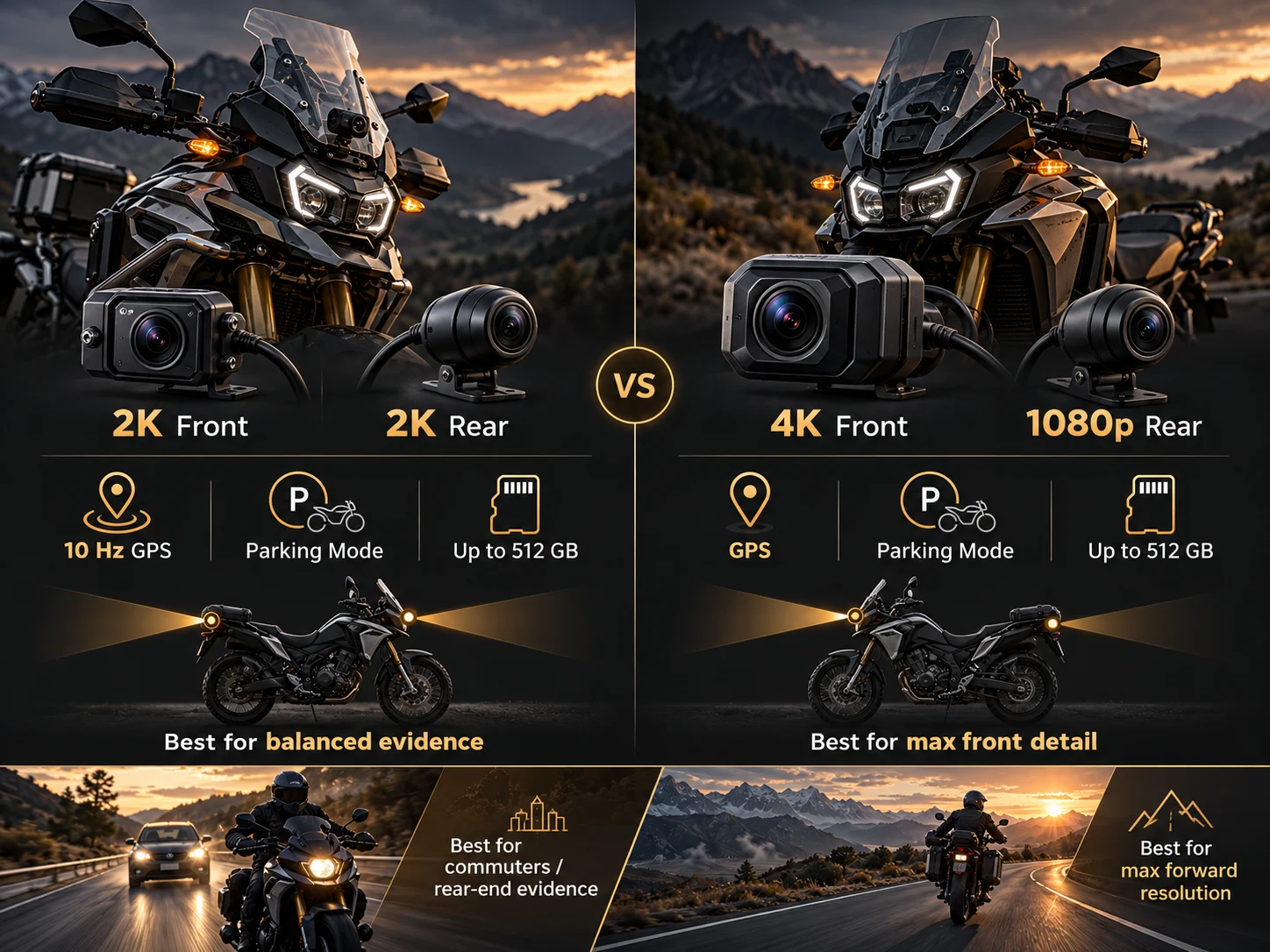
The INNOVV K7 and Vantrue F1 are both serious wired motorcycle dash cams, but they solve the problem differently. The K7 gives you 2K recording from both directions. The F1 pushes harder on the front camera with 4K while using a 1080p rear camera.
If rear-camera detail matters nearly as much as front-camera detail, the K7 is the stronger fit. If maximum forward resolution is your priority and you can find the F1 in current reputable stock, the Vantrue still makes a credible case.
The short answer
Buy the INNOVV K7 if: you want balanced front-and-rear evidence, 2K on both cameras, 10 Hz GPS and an actively sold motorcycle-specific platform.
Buy the Vantrue F1 if: you care most about the sharpest forward recording and can find current stock at a good price.
Our current pick for most riders: INNOVV K7. Vantrue’s own US store currently marks the F1 as sold out, although marketplace stock can still be found. If you prefer to buy through an active manufacturer channel with current direct availability, the K7 is the easier purchase today.
Affiliate disclosure: This page contains affiliate links. If you buy through them I may earn a commission at no cost to you. How HandlebarHQ earns money.
Key differences
- Front camera: K7 2K; F1 4K.
- Rear camera: K7 2K; F1 1080p.
- GPS: both include GPS; K7 uses a 10 Hz module.
- Parking mode: both support parking-surveillance functions.
- Weather protection: both are designed for motorcycle installation and specify IP67 protection.
- Maximum storage: both support up to 512 GB.
- Best fit: K7 for balanced evidence; F1 for maximum front resolution.
Front-camera quality: Vantrue has the resolution advantage
The F1’s headline advantage is simple: 4K front recording. In good light that gives the Vantrue more raw pixels when the relevant vehicle is ahead of you.
That can help when freezing a frame to inspect a plate, sign or other detail, especially when motion blur is under control. But 4K is not a guarantee of readable plates; shutter speed, glare, vibration and relative speed still matter.
Rear-camera quality: K7 wins clearly
The K7’s biggest advantage is the rear camera. It records at 2K rather than 1080p and uses a Sony STARVIS IMX335 sensor, instead of treating the rear channel as a secondary feature.
That matters on a motorcycle because many important incidents happen behind you: tailgating, a rear-end collision at a light or a vehicle moving into your lane from behind.
Night recording
Both systems use Sony sensors designed for lower-light recording, but the same resolution trade-off remains. The F1 has more front-detail potential; the K7 preserves more resolution behind you.
Night footage is difficult for every motorcycle camera because of headlight glare, reflective plates and changing exposure. Neither system should be judged by resolution alone.
GPS and evidence metadata
Both systems support GPS. The K7 specifically uses a 10 Hz GPS module, which records location data more frequently and can create a smoother route trace.
GPS adds context to the video rather than magically making footage conclusive: time, place and movement can all be useful when reconstructing an incident.
Parking mode
Considering recording while the motorcycle is parked? Our motorcycle parking mode battery-protection guide explains supported modes, K7-specific power wiring and starter-battery protection.
Both systems offer parking-surveillance functions. The practical question is whether your motorcycle’s battery and wiring setup make parking mode sensible.
If the bike sits for weeks, battery maintenance matters more than surveillance. If you commute and park in public every day, the feature becomes much more useful.
Installation
Neither product is a five-minute clip-on accessory. Both are permanent motorcycle systems with front and rear cameras, power wiring and components that need sensible locations.
The K7 uses a separate recorder/control architecture, which gives flexibility but creates more pieces to place. Whichever system you choose, inspect the bike first for a protected recorder location, clean camera mounting points and a reliable switched-power source.
App and Wi-Fi
Both systems provide Wi-Fi-based phone access for settings and clip review. That is useful at the roadside, but large transfers are still better handled by removing the memory card and using a computer.
Storage
Both support cards up to 512 GB. Use a reputable high-endurance U3/V30 card. A 256 GB card suits most riders; 512 GB is more useful for long touring days and longer loop history.
Reliability, support and current availability
INNOVV has sold dedicated motorcycle camera systems across several generations, and the K7 remains part of an active current range. That helps with firmware, accessories, documentation and replacement parts.
The F1 needs an availability caveat rather than a blanket rejection. Vantrue’s own US store currently marks the F1 as sold out, while Amazon marketplace stock remains available. That matters because direct-manufacturer availability affects replacement planning and makes current pricing less straightforward.
Price check — October 8, 2026: INNOVV lists the K7 at $388 direct. Vantrue lists the F1 at a $329.99 sale price on its US page but marks it sold out; Amazon marketplace pricing is around $399.99. Prices and stock can change, so use the live retailer links before buying.
Which is better for commuting?
For daily commuting, we prefer the K7. Rear-camera quality matters in dense traffic, and active manufacturer availability reduces ownership friction.
Which is better for touring?
The K7 again has the more balanced evidence setup, while the 10 Hz GPS is a useful extra for route context. Pair either system with a high-endurance 256 GB or 512 GB card for long rides.
Which is better for adventure riding?
Adventure riders should pay particular attention to vibration, camera mounting and G-sensor sensitivity. The K7’s electronic stabilisation options can help on rough-running bikes, although stabilisation comes with a resolution trade-off.
Who should buy the INNOVV K7?
- Riders who want 2K recording from both directions.
- Commuters who care about rear-end evidence.
- Tourers who value 10 Hz GPS and a mature motorcycle-specific ecosystem.
- Owners who want a current product with straightforward manufacturer support.
Who should buy the Vantrue F1?
- Riders who prioritise front-camera resolution above rear detail.
- Buyers who find fresh reputable stock at a meaningful discount.
- Riders who specifically prefer a 4K-front / 1080p-rear strategy.
Final verdict
The Vantrue F1 wins one important specification battle: front-camera resolution. If the only question is which system records more pixels looking forward, it is the F1.
The K7 is the better overall motorcycle evidence system because its rear camera is much stronger, its GPS is more granular and the product remains actively available through the manufacturer.
For most riders buying today, we would choose the K7. Read our full INNOVV K7 review for installation and ownership detail, or see the broader best motorcycle dash cams guide for alternatives.
Frequently asked questions
Is 4K front video better than dual 2K?
It depends on the incident. A 4K front camera gives more forward resolution, while dual 2K gives the rear channel substantially more detail.
Which camera has the better rear recording?
The INNOVV K7. It records the rear channel at 2K, while the Vantrue F1 uses 1080p at the rear.
Is the Vantrue F1 discontinued?
We would not call it discontinued without a manufacturer statement. What we can verify in October 2026 is that Vantrue’s US product page currently shows the F1 as unavailable. Availability should be checked again before buying.
Sources checked
Specifications and support terms were checked against the official INNOVV K7 page, the official Vantrue F1 page and Vantrue’s warranty terms. K7 real-world behaviour was also cross-checked against Ultimate Motorcycling’s independent K7 test.
This page contains affiliate links. If you buy through them I may earn a commission at no cost to you. It does not affect which products I recommend. See the affiliate disclosure and research policy.