
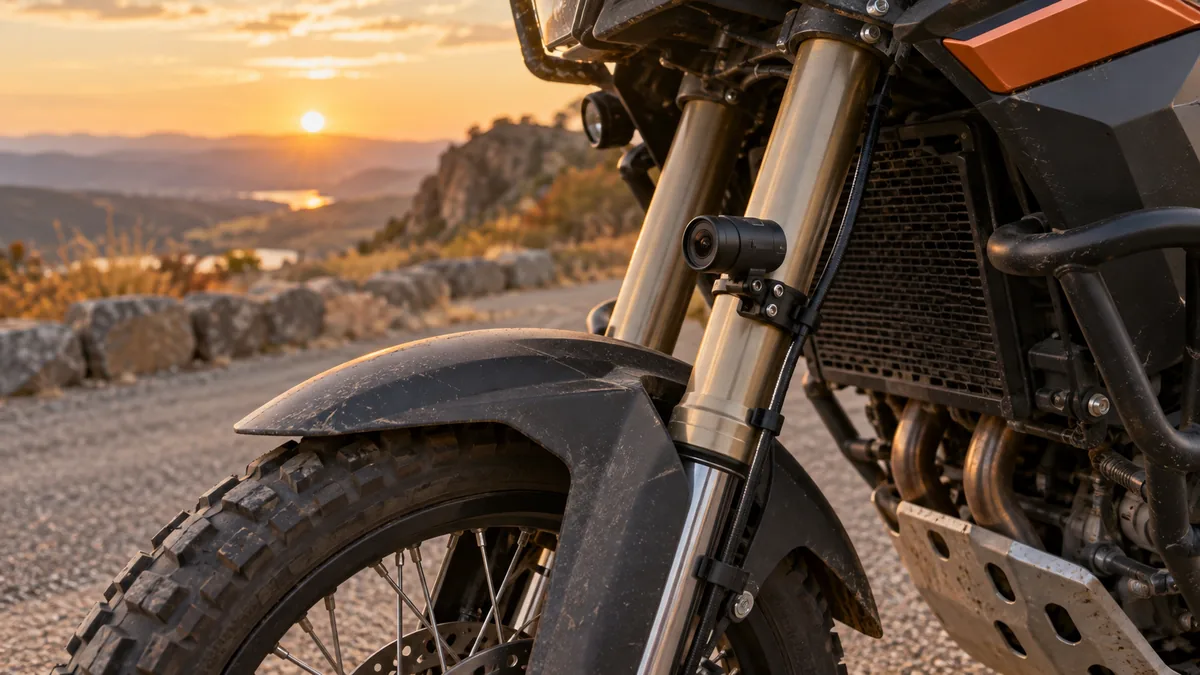
Last updated September 2026. Prices checked at time of writing; INNOVV and Vantrue both run coupons on Amazon most weeks, so the real price is often $30–50 under list.
A motorcycle dash cam has one job: to be recording, without you touching it, at the moment a car turns left across your lane. Everything else — resolution, GPS, apps, parking mode — only matters if that first part is reliable. That’s why this list is weighted heavily towards owner reports over a full season rather than spec sheets, and why the two cheapest categories of camera (helmet action cams and $40 no-name units) don’t make the cut.
Want recording and CarPlay in one cockpit device? Our best motorcycle CarPlay with dash cam guide compares the strongest integrated front-and-rear systems.
It’s built from the manufacturers’ published specs and firmware notes, independent reviews from outlets like Ultimate Motorcycling and Bike EXIF, the INNOVV owner forum, ADVrider threads, and several hundred retailer reviews — weighted towards riders who’ve had a system fitted for months, not days. Sorted by who each one is for, not by a made-up score.
Quick picks
- Best overall: INNOVV K7 — 2K on both cameras, 10 Hz GPS, real parking mode, 2-year warranty. $350–390.
- Best video quality: Vantrue F1 — 4K front camera, the sharpest plates in the category. $400.
- Best value dedicated system: INNOVV K6 — same front sensor as the K7, no control box, simpler install. $220–260.
- Best budget: VSYSTO D6L — dual 1080p, Wi-Fi app, the most-reviewed cheap unit that still works. $80–90.
- Best if you also want CarPlay: Chigee AIO-5 Lite — screen, both cameras and blind-spot detection in one box. $598.
- Best budget screen-plus-cameras: Aoocci C6 Pro — 6.25-inch CarPlay screen with dual 1080p cameras and GPS. $220.
Comparison table
| Model | Front / rear | GPS | Parking mode | Waterproof | Max card | Price (Oct 2026) |
|---|---|---|---|---|---|---|
| INNOVV K7 | 2K / 2K | 10 Hz | Yes | IP67 | 512 GB | $388 |
| Vantrue F1 | 4K / 1080p | Yes | Yes | IP67 | 512 GB | $399.99 |
| INNOVV K6 | 2K / 1080p | No | No | IP67 | 256 GB | $259 (often $220) |
| VSYSTO D6L | 1080p / 1080p | No | No | Waterproof lenses | 256 GB | $82 |
| Chigee AIO-5 Lite | 1080p / 1080p + 5″ screen | Via phone | Sentry mode | IP67 | 256 GB | $598 |
| Aoocci C6 Pro | 1080p / 1080p + 6.25″ screen | Yes | No | IP67 | 256 GB | $218 |
How to read this list
There are three kinds of product that get called a “motorcycle dash cam”, and they suit different riders:
- Dedicated dual-channel systems (INNOVV, Vantrue, VSYSTO) — two small waterproof cameras wired to a recorder under the seat, powered by the bike. They start when you turn the key and stop when you turn it off. No screen, no battery to charge, nothing to remember. This is what most people should buy.
- CarPlay screens with cameras built in (Chigee, Aoocci, CPMC) — a handlebar display that also records front and rear. Good if you wanted a screen anyway; a compromise if you only wanted a camera, because the cameras are usually 1080p and the whole thing costs more.
- Helmet and action cameras (Insta360, GoPro, Sena 50C) — great footage, wrong tool. They run on a battery, you have to remember to start them, and they aren’t loop-recording at 7 a.m. on a Tuesday when the incident happens. They’re covered briefly at the end.
Within the dedicated systems, the things that separate a $80 unit from a $400 one are: sensor quality at night (Sony STARVIS sensors are the marker), GPS for speed and location stamps, parking mode with a low-voltage cutoff, support for large high-endurance cards, and — the one nobody advertises — how well the firmware copes with vibration, heat and marginal SD cards over a year.
1. INNOVV K7 — best overall
Considering recording while the motorcycle is parked? Our motorcycle dash cam parking mode and battery drain guide explains supported modes, K7-specific power wiring and starter-battery protection.
- 2K + 2K
- Sony IMX335 × 2
- 10 Hz GPS
- Parking mode
- IP67 · 512 GB
- 2-yr warranty
- $388
The only system here with matched 2K on both cameras, plus the fastest GPS and a real parking mode. The reference motorcycle dash cam, with a few firmware quirks owners have learned to live with.
Buy a high-endurance V30 card — see below
$388 direct from INNOVV; Amazon was $387.99 at our October 8, 2026 check. 2560×1440 front and rear at 30 fps (or 1080p/60 with stabilisation), Sony STARVIS IMX335 sensors, wide-angle lenses, 10 Hz GPS with GPX export, dual-band Wi-Fi, 24-hour parking mode, aluminium housings, IP67, up to 512 GB, handlebar remote, 2-year warranty.
INNOVV has been building nothing but motorcycle camera systems since 2013, and the K7 is the one every other brand gets compared to. The reason it sits at the top is symmetry: both cameras record at 2K, so the rear view — the one that matters when you’re rear-ended at a light — is as usable as the front. Every other system on this list, including the 4K Vantrue, drops the rear to 1080p. An ADVrider member who upgraded two bikes from older K2 units put it plainly: a 4K-front/1080p-rear system is “half an upgrade”.
The 10 Hz GPS is the fastest in the category and stamps speed and position on the footage, which is what makes a clip useful to an insurer. Parking mode uses the G-sensor to wake the recorder when the bike is knocked, with a low-voltage cutoff so it doesn’t flatten the battery. The aluminium camera bodies double as heat sinks; owners in Arizona and Texas report it keeps recording in conditions that kill plastic-bodied units.
For installation, app behaviour, storage, parking mode and the ownership trade-offs in more depth, read our full INNOVV K7 review.
Now the honest part. The INNOVV owner forum is busy, and three themes repeat. First, SD cards: INNOVV UK told one owner that “99% of the issues are SD card related” — the K7 is fussy about write speed and wants a high-endurance V30 card formatted in the app, not on a computer. Second, the yellow “switched” wire: parking mode only works if that wire sees ignition-switched power, and owners using accessory hubs (Thunderbox, Hex ezCAN) report it misbehaving; wiring it to the licence-plate light circuit is the forum’s standard fix. Third, one documented firmware issue where the last 8–10 seconds of an occasional file goes missing; it’s subtle, and INNOVV had not acknowledged it at the time of writing. The app is functional rather than polished, and turning on stabilisation drops recording to 1080p.
None of that changes the recommendation. Set it up with the right card and a proper switched feed, and this is the system with the best chance of having the footage when you need it.
Also consider: INNOVV K5 (4K front, ~$400)
Same family, 4K front camera and 5 Hz GPS, but the rear stays at 1080p and INNOVV lists it as limited availability. If you specifically want 4K front footage, the Vantrue below is easier to find.
2. Vantrue F1 — best video quality
- 4K front / 1080p rear
- Sony STARVIS
- GPS
- 5 GHz Wi-Fi
- IP67 · 512 GB
- Wired remote
- $399.99
The sharpest front footage in this group and an established motorcycle dash cam on Amazon. The rear camera and the app are where it gives ground to the K7.
Renewed units appear at ~$280 — check the return policy
$399.99 on Amazon at our October 8, 2026 check. 3840×2160 front at 30 fps, 1080p rear, Sony STARVIS sensors, 160° lenses, built-in GPS with speed overlay, 5 GHz Wi-Fi, parking mode, wired handlebar remote, IP67, up to 512 GB, with Vantrue warranty coverage up to 18 months after registration.
Vantrue makes car dash cams by the million and brought that experience to a motorcycle kit in 2023. The F1 remains well established on Amazon, with a 4.2-star average across 220+ ratings at our October 8, 2026 check, and the main reason to choose it is the front camera. In daylight, 4K reads plates at distances where 2K is guessing, and the STARVIS sensor holds up at night better than most owners expect. If your riding is urban commuting where the threat is in front of you, this is the camera that produces the most useful evidence.
The trade-offs are the rear camera and the software. The rear is 1080p, so the view that matters in a rear-end collision is a step behind the K7’s. There’s no meaningful stabilisation, which on a single-cylinder or a V-twin shows up as jitter at idle. The 160° lenses capture more but distort more — a car that looks 30 feet back may be 15. And the app is basic: it works for downloading clips and changing settings, and not much else. Owners also note the recorder box is larger than INNOVV’s, which matters on bikes with no room under the seat.
If you are deciding specifically between these two systems, see our INNOVV K7 vs Vantrue F1 comparison for the front-versus-rear resolution trade-off, current availability and warranty differences.
Buy the F1 if front-camera detail is your priority; buy the K7 if you want both ends covered equally. Both are good decisions.
3. INNOVV K6 — best value dedicated system
- 2K front / 1080p rear
- IMX335 + IMX307
- No control box
- Wi-Fi app
- IP67 · 256 GB
- 2-yr warranty
- $259 (often $220)
The K7’s front sensor in a simpler package with the recorder built into the front camera. No GPS and no parking mode — for a lot of riders that’s fine, and it’s $130 cheaper.
Easiest install on naked and sport bikes
$259 list, regularly $220 with coupon. 2560×1440 front (Sony IMX335), 1080p rear (Sony IMX307), 140° lenses, recorder built into the front camera, 2.4 GHz Wi-Fi, G-sensor, IP67 with 0.5 m submersion rating, up to 256 GB, 2-year warranty.
The K6 is what you buy when you’ve decided you want an INNOVV but can’t justify $350. It uses the same front sensor as the K7, so daytime front footage is close to identical, and it drops the separate recorder box: the DVR lives inside the front camera, which means two cables instead of six and nothing to find space for under the seat. On a naked bike or a sport bike with a tail unit full of electronics, that alone can be the deciding factor.
What you give up is GPS, parking mode and the 2K rear. No GPS means no speed stamp on the footage; no parking mode means it’s off when the key is off. The rear camera is the older 1080p sensor. Amazon’s owner rating (4.0 across 110 reviews) matches the K7’s, with the same SD-card complaints and the same advice: use a high-endurance card and format it in the app.
If you mostly ride during the day, park in a garage and want a system that will still be working in three years, this is the sensible INNOVV.
4. VSYSTO D6L — best budget
- 1080p + 1080p
- 130° lenses
- Starlight night sensor
- Wi-Fi app
- Waterproof lenses
- 256 GB
- $82
The cheap dual-channel system with enough owner history (350+ reviews) to trust. Daytime footage is fine, night footage is usable, and the price is a quarter of the K7’s.
No GPS, no parking mode — know what you're buying
$82. 1920×1080 front and rear at 30 fps, 130° lenses, “starlight” low-light sensor, Wi-Fi app for playback and settings, G-sensor lock, loop recording, waterproof camera heads, up to 256 GB, wired controller.
There are dozens of sub-$100 motorcycle cameras on Amazon and most of them are the same three factory designs with different logos. VSYSTO is the exception worth naming, because it’s been selling the D6L under its own brand for years and has the review history to prove it — 4.1 stars across 358 reviews at the time of writing, which is more owner data than any other cheap unit. Riders report the daytime footage is clear enough to read plates at close range, night footage is usable if not pretty, and the app works.
What you don’t get: GPS, parking mode, stabilisation, an aluminium housing or a meaningful warranty. The recorder box is plastic, so it needs a spot away from exhaust heat. Wide-angle distortion is noticeable. A minority of owners report units failing after a season, which at this price is the trade you’re making.
If the choice is a D6L or no camera at all, buy the D6L. If you can stretch to $220, the K6 is a different class of product.
Also consider: VSYSTO 2K D6WL ($110)
The same system with 2K sensors and 5 GHz Wi-Fi, launched this year. Too new to have an owner track record; if the 1080p unit’s history carries over it will be the better buy in six months.
5. Chigee AIO-5 Lite — best if you also want CarPlay
- 5" CarPlay screen
- 1080p front + rear
- Blind-spot detection
- Sentry mode
- IP67 · 256 GB
- 1-yr warranty
- $598
Screen, cameras and radar-free blind-spot alerts in one box. The right answer if you wanted a CarPlay screen anyway; expensive if you only wanted a camera.
Full review linked below
$598. 5-inch 1200-nit CarPlay/Android Auto screen, 1080p front and rear cameras included, camera-based blind-spot detection, sentry (parking) mode, CG OS, IP67, up to 256 GB, 1-year warranty.
This is a different product category — a handlebar screen that happens to include cameras — but it belongs on the list because a lot of riders searching for a dash cam end up here. The AIO-5 Lite’s cameras are 1080p, so the footage is a step behind the dedicated systems above, but it does two things none of them can: it shows the rear camera on the screen while you ride, and it uses that camera to flash a blind-spot warning when a car sits in your six. Sentry mode records when the parked bike is disturbed.
The full breakdown — including why the 5-inch screen is the reason most riders should build a Chigee AIO-6 Max with the camera add-on instead — is in the Chigee AIO-5 Lite review. The short version: buy it if you want a compact all-in-one and a 5-inch screen suits your bike; otherwise buy the K7 and a separate screen from the best motorcycle CarPlay screens list.
6. Aoocci C6 Pro — best budget screen-plus-cameras
- 6.25" CarPlay screen
- 1080p front + rear
- GPS
- Emergency lock
- IP67 · 256 GB
- 140° lenses
- $218
A CarPlay screen and a dual dash cam for less than the K6 alone. The cameras are ordinary; the value is not.
1080p cameras — evidence, not cinema
$218. 6.25-inch touchscreen with wireless CarPlay and Android Auto, 1080p front and rear cameras, built-in GPS, 140° lenses, G-sensor emergency lock, IP67, up to 256 GB.
Aoocci is the budget brand from the CarPlay-screen world, and the C6 Pro is its dash cam bundle: a 6.25-inch screen plus two 1080p cameras plus GPS for under $220. That’s cheaper than a K6 with no screen. Amazon owners rate it 4.1 stars across about 100 reviews, with the usual budget-screen caveats — daylight brightness is adequate rather than good, the software is simpler than Chigee’s, and support is via the seller.
The cameras are the weak point. They’re 1080p with 140° lenses and no stabilisation, and the footage is fine for establishing what happened, not for reading a plate two cars back at night. If the camera is the priority, buy a dedicated system. If you want a screen and would like a camera thrown in, this is the cheapest sensible way to get both.
Also consider: CPMC X6 ($275–349)
A 6.5-inch screen with a 2K front camera, 1080p rear and TPMS included, from a US-based seller with a phone number. Better cameras than the Aoocci for $60–130 more; it’s covered in the CarPlay screen roundup.
The ones I didn’t pick, and why
- Thinkware M1 (~$380): the best 1080p night footage in the category and a superb build, but a UK rider who contacted Thinkware in early 2025 was told it’s no longer in production with no replacement planned. It’s still on some shelves; buy it at a clearance price or not at all.
- Magellan 2.5K dual (~$360): new this year — 2.5K front and rear, HDR, GPS, a 3-year warranty and early reviews averaging 4.5 stars. Promising, but around 30 owners is too few to judge a product whose whole value is reliability. Worth a look in six months; the 64 GB card ceiling is an odd limitation.
- INNOVV N2 ($441): a 6-inch CarPlay screen with 2K/2K cameras from the K7 people, launched mid-2026. Fifteen reviews. If it inherits the K7’s cameras and the screen is good, it could replace the AIO-5 Lite on this list next year.
- Generic “2K EIS” dual systems ($120–160): the Amazon search results are full of them, sold under names that change every few months. Some are fine; there’s no way to know which, and no one to call when the firmware bricks.
- Sena 50C, Insta360 X5, GoPro: excellent cameras, not dash cams — see the next section.
Dash cam, action camera, or a screen with cameras?
A dash cam is wired to the bike, records in a loop from key-on to key-off, locks the file when the G-sensor trips, and needs no attention. A helmet or action camera records better-looking footage from a better angle, but runs on a battery that lasts 1–2 hours, has to be started by hand, and is usually off when something goes wrong. Riders who want both typically run a dash cam for evidence and an Insta360 or GoPro for the good roads. The Sena 50C is the interesting exception — a helmet intercom with a camera built in — but it’s still a battery device you have to remember.
A CarPlay screen with cameras is the right compromise if you were going to buy a screen anyway and want to see the rear camera while riding. The cameras are almost always 1080p, and the screen adds $150–400 to the price of the cameras alone. If you only want a camera, skip the screen; the CarPlay screen vs GPS guide covers when a screen is worth having in its own right.
Things nobody tells you before you buy
The SD card is the number one cause of failures
Across INNOVV’s forum, Vantrue’s reviews and the budget units, the same story repeats: recorder “stops recording”, “missing files”, “won’t turn on” — and it’s the card. Motorcycle dash cams write continuously in heat and vibration, which ordinary cards aren’t rated for. Buy a high-endurance card (SanDisk High Endurance, Samsung PRO Endurance, or the Viofo industrial cards INNOVV’s UK distributor recommends), V30/U3 rated, 128–256 GB, and format it in the camera’s app, not on a computer. Reformat every couple of months. A $25 card is the cheapest reliability upgrade in this article.
The switched wire is where installs go wrong
Every system with parking mode has two power inputs: a constant feed from the battery and a “trigger” wire that should only be live with the ignition on. That trigger is how the camera knows you’ve parked. If it’s wired to a circuit that stays live — or to an accessory hub that behaves unpredictably — parking mode never engages, or the camera never shuts down. The INNOVV forum’s standard advice is to take the trigger from the licence-plate light. Whatever you use, fuse the constant feed at the battery; the phone-charging guide covers the relay-and-fuse approach that also suits a dash cam.
Parking mode is a battery trade
Sentry-style parking mode keeps the recorder on standby, which draws current. The good systems (K7, F1) have a low-voltage cutoff that switches off before the bike won’t start; the cheap ones don’t have parking mode at all, which is arguably safer. On a bike that sits for weeks, turn it off or put the bike on a tender.
Where the cameras go matters more than the resolution
Front camera: below the headlight, on a fork leg, or under a beak — level, forward, and out of the spray line. Rear camera: on the plate bracket or under the tail, away from the exhaust. Owners who mount the rear camera near a muffler report heat-related failures on plastic-bodied units. Mount low enough that your own body and luggage don’t fill the frame, and clean the lenses; a week of road film makes 4K look like 480p.
Stabilisation costs resolution
Electronic image stabilisation on the K7 and similar units crops the frame and drops output to 1080p. On a smooth twin you may prefer full 2K without it; on a thumper or a big V-twin, smoother 1080p is usually the more readable footage. Try both.
Footage is only evidence if it’s stamped
A clip with a GPS speed and time overlay is far harder to dispute than one without. That’s the practical case for the K7 or F1 over the K6 and the VSYSTO — not the image quality, the metadata.
Frequently asked questions
Is a motorcycle dash cam worth it?
If you ride in traffic, yes. Insurers and police treat clear footage as decisive, and riders are disproportionately blamed in collisions where there’s no video. A $220 K6 costs less than one insurance excess.
Can I use a car dash cam on a motorcycle?
Not sensibly. Car units aren’t waterproof, aren’t built for vibration, and have nowhere to mount. The dedicated systems here separate the sealed cameras from a recorder that lives under the seat.
Will a dash cam drain my motorcycle battery?
While riding, no. Parked with parking mode on, slowly — which is why the better units have a voltage cutoff. With parking mode off, or on units without it, the camera is fully off with the key.
How much footage does a 256 GB card hold?
Roughly 10–12 hours of dual 2K on a K7, 20+ hours of dual 1080p. Loop recording overwrites the oldest files, so what matters is that the card holds more than your longest ride before you get a chance to save a clip.
Is it legal to record while riding?
In the US, recording video in public is legal in every state. Audio is the grey area in two-party-consent states, and most of these cameras record audio by default; turn it off if that concerns you. Outside the US, check local rules — some European countries restrict dash cam use.
This page contains affiliate links. If you buy through them I may earn a commission at no cost to you. It doesn’t affect which products I recommend — see the disclosure and research policy.