
Last updated October 2026. This review uses INNOVV’s published specifications and firmware information, independent motorcycle testing and long-term owner reports. No hands-on testing is claimed.
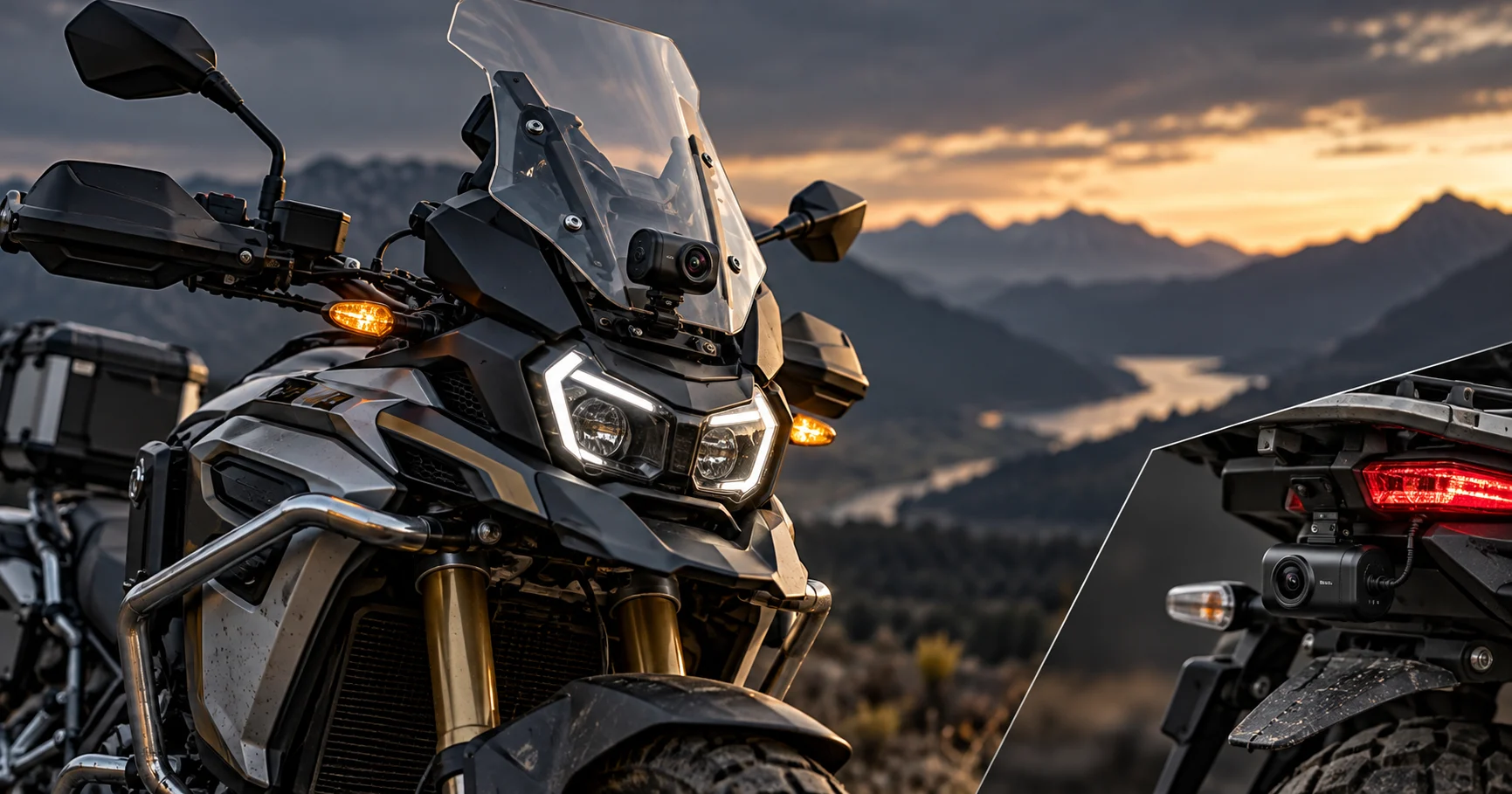
The INNOVV K7 is one of the few dedicated motorcycle dash cams that records at 2K from both the front and rear cameras. That matters because many motorcycle incidents develop behind the rider, where a lower-resolution rear camera can become the weak link.
If you prefer a single screen that combines CarPlay and recording, compare the integrated alternatives in Best Motorcycle CarPlay With Dash Cam.
Matched front-and-rear recording, 10 Hz GPS, parking surveillance, ignition-controlled operation and motorcycle-specific weather protection are why the K7 currently sits at the top of our best motorcycle dash cams guide.
INNOVV K7: the short verdict
Best for: riders who want equally strong front and rear evidence recording, GPS metadata and a permanent system that needs very little attention after installation.
Skip it if: maximum front-camera resolution matters more than rear detail, you want the simplest installation possible, or your budget is much closer to $100 than $400.
- What we like: 2K front and rear recording; Sony STARVIS sensors on both cameras; 10 Hz GPS; parking mode; dual-band Wi-Fi; IP67 hardware; up to 512 GB storage; two-year warranty.
- What we don’t: more wiring than a basic system; electronic stabilisation reduces available resolution; rough roads can trigger protected clips; the app is functional rather than exceptional.
Affiliate disclosure: This page contains affiliate links. If you buy through them I may earn a commission at no cost to you. How HandlebarHQ earns money.
Key specifications
- Front camera: 2K, 2560 × 1440 at 30 fps.
- Rear camera: 2K, 2560 × 1440 at 30 fps.
- Sensors: Sony STARVIS IMX335 front and rear.
- Lens: f/1.8.
- GPS: 10 Hz.
- Wi-Fi: 2.4 GHz and 5.8 GHz.
- Parking mode: yes.
- Electronic stabilisation: yes, with a resolution trade-off.
- Maximum storage: 512 GB.
- Weather protection: IP67.
- Warranty: two years.
The standout specification is the matched front and rear cameras. Many motorcycle systems spend most of their hardware budget on the front sensor and use a lower-resolution rear camera. The K7 instead treats both directions as evidence channels.
Why dual 2K matters on a motorcycle
A car following too closely, moving into your lane or hitting you while you are stopped can make rear footage the primary evidence. A 4K-front/1080p-rear system may look more impressive on a spec sheet, but that advantage disappears when the relevant vehicle is behind you.
The K7’s approach is less about winning a resolution contest and more about balanced evidence coverage. That is the main reason we prefer it as a complete motorcycle system.
Daytime and night recording
At full resolution the K7 records both channels at 2K and 30 fps. That is enough for useful road evidence without the storage demands of dual 4K recording.
No dash cam guarantees a readable licence plate in every situation. Distance, closing speed, shutter speed, glare, headlight reflection and vibration all matter. What the K7 does well is avoid making the rear camera the obvious weak link.
Both cameras use Sony STARVIS sensors for improved low-light sensitivity. Night footage still has to deal with opposing headlights, reflective plates and wet roads, but comparable sensors front and rear help preserve consistency.
Electronic image stabilisation: useful, with a trade-off
Motorcycles are difficult camera platforms. Engines generate high-frequency vibration, road surfaces create larger impacts and brackets can amplify movement.
The K7 includes electronic image stabilisation, but the stabilised modes use lower-resolution output than the maximum dual-2K mode. Start at full 2K; if your bike produces excessive vibration, test the stabilised mode and compare the result.
GPS and evidence metadata
The K7 includes a 10 Hz GPS module. Compared with a conventional 1 Hz receiver, it records location data more frequently, producing a smoother route trace and more granular speed and position information.
GPS does not make a clip automatically decisive, but it can add useful context to the video: where the motorcycle was, when the event happened and how the ride progressed.
Parking mode
Considering recording while the motorcycle is parked? Our parking mode and battery-drain installation guide explains supported modes, K7-specific power wiring and starter-battery protection.
The K7 supports impact-triggered parking surveillance. When installed correctly, the system can remain ready after the motorcycle is switched off and protect relevant footage if the G-sensor detects an impact.
Anything monitoring a parked motorcycle still needs power. Riders who leave a bike unused for long periods should balance parking surveillance against battery health.
The G-sensor can be too enthusiastic
Independent motorcycle testing has highlighted a predictable issue: rough riding can trigger the G-sensor. When the system interprets a bump as an impact it protects that video so loop recording cannot overwrite it.
That is exactly what you want during a collision, but it can become annoying on rough roads. Adventure riders should tune the sensitivity instead of assuming the default suits every bike.
Installation: the K7’s biggest practical drawback
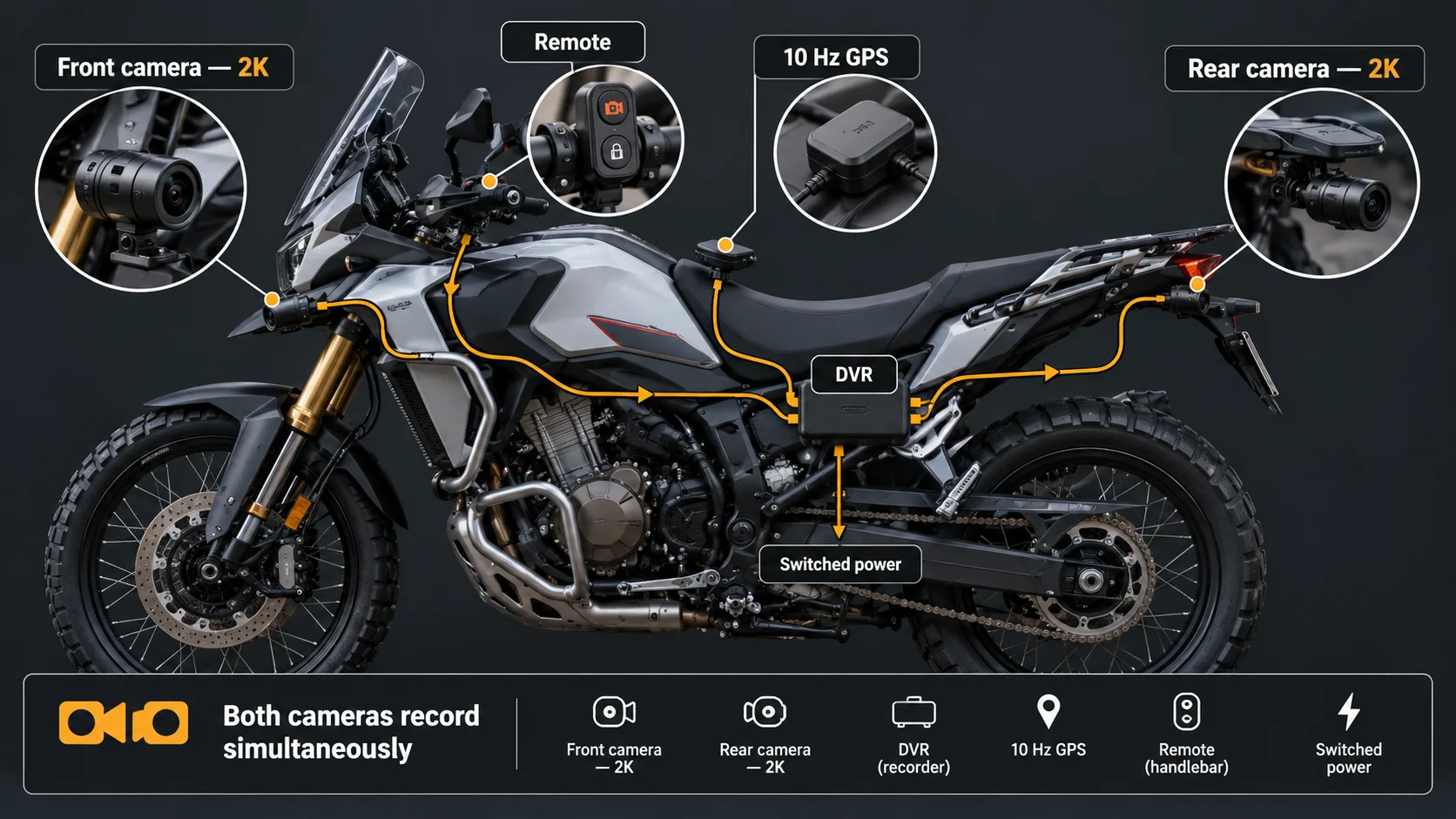
The K7 is a permanent motorcycle system, not a camera that clips onto a helmet. Once installed, that is an advantage: it starts automatically, there are no camera batteries to charge and you do not have to remember to press record.
The price of that convenience is wiring. You need to place front and rear cameras, the recorder, GPS module, remote, microphone and power connections sensibly.
- Choose the front-camera position before routing cable.
- Keep the rear camera away from exhaust heat and luggage.
- Find a protected home for the recorder before committing to cable lengths.
- Check full steering lock and suspension movement before securing wiring.
- Use a sensible switched-power source and fuse the system correctly.
The cleaner the planning stage, the easier the installation becomes.
Automatic recording is the point
Properly wired, the K7 starts recording with the motorcycle and shuts down or transitions into its configured parking behaviour when the ignition is switched off.
That matters because the best accident camera is not necessarily the one with the highest resolution. It is the camera that was recording.
Wi-Fi and the INNOVV app
Dual-band Wi-Fi lets the phone app connect directly to the K7 for settings, clip review and system management. That is useful at the roadside, although transferring a large volume of footage is still faster by removing the memory card and using a computer.
Memory cards matter more than most buyers expect
Continuous recording is unusually hard on flash storage. The camera writes repeatedly, deletes older footage and operates through heat, vibration and temperature swings.
INNOVV specifies U3/V30-class cards and supports up to 512 GB. We would use a high-endurance card from a reputable brand rather than choosing purely by capacity or price.
For most riders, 256 GB is a sensible starting point. Move to 512 GB if you tour, record very long days or want more history before loop recording overwrites older footage.
Weather protection
The K7 hardware is rated IP67, which is appropriate for permanent motorcycle installation through rain and road spray. Connectors and cable routing still need care; an IP rating is a safety margin, not a substitute for good installation.
Reliability: what to monitor
- Memory-card health: periodically confirm that new recordings are being created and can be played.
- G-sensor sensitivity: reduce it if normal bumps generate large numbers of protected clips.
- Cable security: inspect mounts and routing after long rides or rough-road use.
INNOVV K7 vs K6
The K6 is the simpler, cheaper INNOVV. It gives you a 2K front camera, 1080p rear recording and a less complicated installation.
The K7 earns its higher price with 2K rear recording, GPS, parking mode and a more complete recorder architecture. If you mostly ride during the day and park in a garage, the K6 is sensible. If you specifically want stronger rear evidence and GPS metadata, choose the K7.
INNOVV K7 vs Vantrue F1
The Vantrue F1 takes a different approach: 4K at the front and 1080p at the rear. The K7 records 2K in both directions.
Choose the F1 if maximum forward resolution is your main priority. Choose the K7 if you want more balanced evidence coverage. There is also a current availability issue: Vantrue’s US page lists the F1 as unavailable in October 2026.
We break down that decision in the dedicated INNOVV K7 vs Vantrue F1 comparison.
Who should buy the K7?
- Daily commuters who want automatic evidence recording.
- Touring riders who value GPS metadata and long loop history.
- Riders who consider rear evidence as important as front evidence.
- Owners who can accommodate a permanent recorder and clean cable routing.
- People who regularly park in public places and value parking surveillance.
Who should buy something else?
- Riders who want 4K front recording above everything else.
- Motorcycles with virtually no space for a recorder and wiring.
- Occasional riders who prefer a removable camera.
- Buyers with a much smaller budget.
- Riders who mainly want scenic footage rather than unattended evidence recording.
Is the INNOVV K7 worth it?
For riders who want a serious permanently installed motorcycle dash cam, yes. The K7’s strongest argument is not a single headline specification; it is the completeness of the evidence system: matched 2K cameras, high-frequency GPS, ignition-controlled operation, parking surveillance, weatherproof hardware and large-card support.
The drawbacks are the predictable consequences of that completeness. It costs more, needs more installation work and depends on a good memory card and sensible setup. Once installed correctly, though, there is very little for the rider to remember.
Frequently asked questions
Does the INNOVV K7 record in 4K?
No. Its headline configuration is 2K front and 2K rear. Its advantage is balanced resolution rather than a 4K front camera paired with a lower-resolution rear camera.
Does the K7 have parking mode?
Yes. It supports G-sensor-based parking surveillance when installed and configured correctly.
What size SD card does the K7 support?
INNOVV specifies cards up to 512 GB. Use a reputable high-endurance U3/V30 card.
Is the INNOVV K7 waterproof?
The system is specified at IP67. Wiring and connectors should still be installed carefully.
Does the K7 start automatically?
Yes. Properly wired, it begins recording with the motorcycle and handles shutdown automatically.
Sources checked
Specifications, warranty and current product details were checked against the official INNOVV K7 product page. Real-world installation, vibration and G-sensor observations were cross-checked against Ultimate Motorcycling’s independent K7 test.
This page contains affiliate links. If you buy through them I may earn a commission at no cost to you. It does not affect which products I recommend. See the affiliate disclosure and research policy.