
Last updated October 8, 2026. Prices and specifications were checked against current Sena, Cardo and Amazon listings. This guide is specifically for a rider and passenger or two riders who usually travel together — not large mesh groups.
The best motorcycle intercom for a rider and passenger is usually not the most expensive mesh system. Two people sitting on the same motorcycle do not need five miles of chained mesh range or support for 31 riders. They need clear two-way speech, easy controls, reliable pairing, comfortable speakers and enough battery for the day.
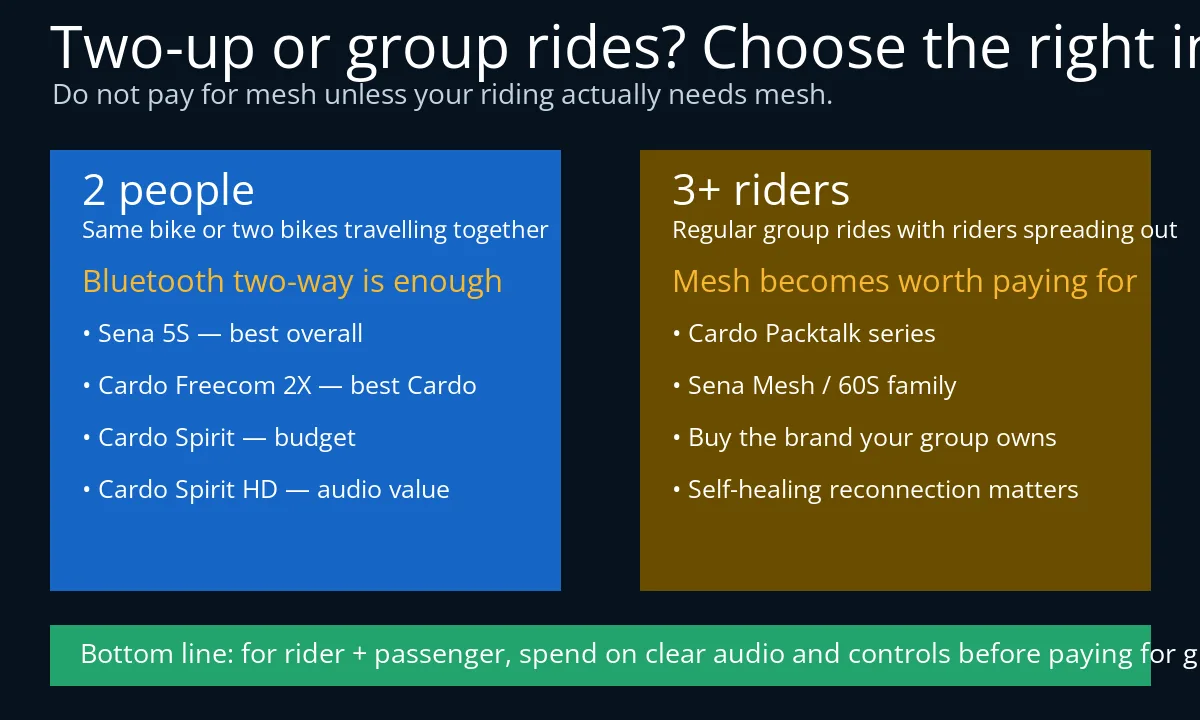
That changes the value calculation completely. A Sena 5S, Cardo Freecom 2X or even a Cardo Spirit can handle the core rider/pillion job for far less than a Packtalk Pro or Sena 60S. Buy mesh only if the same pair also joins larger riding groups.
Quick picks
- Best overall for rider + passenger: Sena 5S — simple two-way Bluetooth, good glove controls, HD speakers, music sharing and a current Amazon price around $152 per unit.
- Best Cardo two-up: Cardo Freecom 2X — JBL audio, live two-way intercom and the Cardo ecosystem without paying for mesh.
- Best value: Cardo Spirit — inexpensive, simple and enough if conversation/GPS matter more than premium audio.
- Best audio-focused value: Cardo Spirit HD — larger 40 mm speakers and FM radio without stepping up to mesh.
- Buy mesh only if you also ride in groups: Packtalk Edge/Pro or Sena 60S.
Affiliate disclosure: This page contains affiliate links. If you buy through them I may earn a commission at no cost to you. How HandlebarHQ earns money.
Why most rider/passenger pairs do not need mesh
Mesh solves a group problem. In a line of multiple motorcycles, riders spread out, get separated at junctions and move in and out of range. Mesh lets the network rebuild automatically instead of forcing everyone to repair a Bluetooth chain.
A rider and pillion are usually less than a metre apart. Even two motorcycles travelling together do not need a 31-rider network. Standard two-way Bluetooth is cheaper, simpler and usually gives you everything that matters.
Spend on mesh if you also join group rides. Otherwise, put the money into better helmets, earplugs or a dual-pack deal.
1. Sena 5S — best overall for two-up
The Sena 5S is almost purpose-built for this job: Bluetooth 5.1, two-way HD intercom, HD speakers, music sharing, GPS prompts, an LCD status display and the big Sena jog dial. Sena quotes up to 700 m of intercom range in ideal conditions, which is vastly more than a rider and passenger require.
The jog dial is the practical reason we put it first. A pillion should be able to change volume or answer a call with thick gloves without learning a sequence of tiny button presses. The 5S remains one of the easiest interfaces in the category.
On October 8, Amazon listed the 5S single pack at about $152.10. Two singles or a dual pack are still much cheaper than a premium mesh pair.
The compromise is age and weather documentation. The 5S is a mature design, not Sena’s newest hardware, and Sena’s current product page does not publish the sort of explicit IP rating Cardo emphasizes on many of its models.
2. Cardo Freecom 2X — best Cardo option
The Freecom 2X is the Cardo answer for people who know they only need two riders. It gives you JBL-branded audio, live two-way Bluetooth intercom, the Cardo control wheel and cross-brand connectivity without paying for DMC mesh.
Cardo currently lists it at $254.95 single; Amazon was around $229.46 on October 8, with the dual pack around $427.46. That is more expensive than the Sena 5S, but it keeps you inside Cardo’s app/accessory ecosystem and gives you Cardo’s current audio tuning.
If you and your passenger already use Cardo on other helmets or bikes, the Freecom 2X is the natural non-mesh choice.
3. Cardo Spirit — best budget choice
The basic Cardo Spirit is the answer when you mainly want to talk, hear navigation and take calls. Amazon was around $98.95 per unit on October 8, which means a pair can cost less than a single Freecom 2X.
You give up premium speakers and higher-end controls, not the basic two-way communication function. For an occasional passenger, second helmet or couple that rides a few weekends a month, this is often the sensible spend.
4. Cardo Spirit HD — best budget audio upgrade
Spirit HD keeps the simple two-rider formula and adds 40 mm HD speakers, FM radio and a stronger audio package. Amazon was around $161.96 for a single and about $305.96 for a dual pack on October 8.
That puts it close to Sena 5S money. Choose the Spirit HD if you prefer Cardo and care more about music/audio quality; choose the 5S if you prefer Sena’s jog dial and LCD interface.
When a Packtalk or Sena mesh system is worth the extra money
If the rider/passenger pair also joins groups of three or more motorcycles, the answer changes. Mesh becomes valuable because the network self-heals when bikes spread out or reconnect.
In that case, buy the same mesh ecosystem as the group. Cardo riders should look at Packtalk Edge or Pro; Sena groups should look at the 60S/50S family.
For the wider market, see Best Motorcycle Intercoms. If you are choosing a brand ecosystem, use Cardo vs Sena.
Rider/passenger versus rider/rider: does range matter?
For a pillion on the same motorcycle, quoted range is almost irrelevant. For two separate bikes, it matters more, but manufacturer maximums are measured in ideal line-of-sight conditions. Hills, trees, trucks and buildings cut real-world range substantially.
Reconnection behaviour and microphone clarity are more useful than chasing the largest range number on a box.
Music sharing
Music sharing sounds like a must-have until you try to use it with conversation, GPS prompts and calls. Some units prioritize or pause sources differently, and lower-cost Bluetooth systems may not let you freely mix everything at once.
If shared music is central to the trip, check the exact behaviour of the chosen pair and firmware version. If conversation is the priority, almost every model here handles that well.
Microphone choice matters more than brand
A full-face helmet normally wants a wired mic placed inside the chin bar. A modular/open-face helmet usually needs a boom microphone. Choose a kit that includes the right microphone rather than assuming one setup fits every helmet.
Placement matters too: put the mic close to the mouth but out of direct breath flow, and use the supplied windsock. Many “bad intercom” complaints are really bad mic placement.
Speaker placement and wind noise
Centre the speakers over the ear canals. Even a 5–10 mm offset can make a premium speaker sound quiet and thin. Use spacers if the helmet has deep speaker pockets.
At highway speed, helmet aerodynamics and earplugs dominate. No 40 or 45 mm helmet speaker can overpower severe wind noise safely. A quieter helmet and correctly fitted earplugs can improve intelligibility more than moving from a midrange intercom to a flagship.
Battery life
For two-up touring, the target is simple: survive a full day. Most current units here can do that under normal use, although constant intercom and cold weather reduce runtime. USB-C fast charging during a lunch stop is worth more than chasing a huge quoted number.
Should couples buy a dual pack?
Usually yes, if the dual pack is meaningfully cheaper than two singles. It also simplifies matching hardware and ensures both helmets start with the same firmware generation.
But compare live pricing. Amazon discounts singles and dual packs unevenly, and there are times when two discounted singles cost less than the “bundle.”
Best setup by use case
- Same-bike rider + pillion: Sena 5S or Cardo Spirit/Spirit HD. Mesh is unnecessary.
- Two bikes, always together: Sena 5S or Freecom 2X. Pay for better audio/controls before mesh.
- Couple that also joins group rides: buy the mesh ecosystem used by the group.
- Occasional passenger: Cardo Spirit is enough; do not overspend on a second flagship.
- Audio-first couple: Freecom 2X or Spirit HD before jumping to Packtalk.
Final verdict
For a rider and passenger, our default pick is the Sena 5S because it does the two-way job cleanly, has excellent glove controls and is currently priced well below premium mesh hardware.
If you prefer Cardo, the Freecom 2X is the stronger premium two-up choice, while Spirit and Spirit HD cover the value end. Only buy Packtalk or Sena mesh if your riding life actually includes larger groups.
Frequently asked questions
Do a rider and passenger need mesh intercom?
Usually no. Two-way Bluetooth is enough when there are only two people and they stay together. Mesh becomes useful when the same riders join larger groups.
What is the best intercom for a rider and pillion?
For most couples, we would start with the Sena 5S. Cardo users should compare the Freecom 2X and Spirit HD depending on budget.
Can Cardo and Sena talk to each other?
Modern units can use universal Bluetooth cross-brand pairing, but Cardo DMC and Sena Mesh do not join the same native mesh network.
Should I buy a dual pack?
Usually, but check live prices first. Two discounted singles can occasionally cost less than a dual pack.
Sources checked
Sena 5S specifications were checked against the official Sena 5S page. Freecom 2X and Spirit HD details were checked against current Cardo Freecom 2X and Cardo product listings. Amazon prices were checked on October 8, 2026.
This page contains affiliate links. If you buy through them I may earn a commission at no cost to you. See the affiliate disclosure and research policy.