
Last updated October 8, 2026. This review uses current Cardo specifications, live Amazon pricing, our existing Edge-vs-Pro research and owner/reviewer evidence. No hands-on testing is claimed.
The Cardo Packtalk Pro is an excellent motorcycle intercom. The harder question is whether it is an excellent buy. At a $499.95 list price, it asks roughly flagship-helmet money for an intercom whose core communication experience is very close to the cheaper Packtalk Edge.
The Pro earns its premium with three things: 45 mm JBL speakers, automatic on/off and Cardo’s crash-detection system. If one of those matters to you — especially crash detection for frequent solo riding — the upgrade makes sense. If you mainly want Cardo’s mesh, Air Mount, waterproofing and voice control, the Edge remains the smarter value.
Cardo Packtalk Pro: the short verdict
Best for: solo and touring riders who want Cardo’s best hardware, larger speakers and crash detection in one unit.
Skip it if: you mostly ride in a group, already own a Packtalk Edge, or do not care about crash detection and automatic power management.
- What we like: 45 mm JBL speakers, 2nd-generation DMC mesh, Air Mount, IP67 design, crash detection, auto on/off, natural voice control, 13-hour battery and 3-year warranty.
- What we do not: high list price, crash detection depends on the Cardo app/cloud ecosystem, audio upgrade is incremental rather than transformative, and Edge delivers most of the communication experience for less.
Affiliate disclosure: This page contains affiliate links. If you buy through them I may earn a commission at no cost to you. How HandlebarHQ earns money.
Current price: the Pro is easier to justify on sale
Cardo lists the Packtalk Pro at $499.95. On October 8, 2026, Amazon was selling the single unit for about $424.96, while the Packtalk Edge was around $394.96. That roughly $30 live-price gap is much easier to justify than the $60 list-price gap.
This is why the answer changes with the retailer. At full list price, the Edge is the value pick. When the Pro is discounted close to Edge money, the larger speakers and safety features become much more attractive.
What the Packtalk Pro actually adds over the Edge
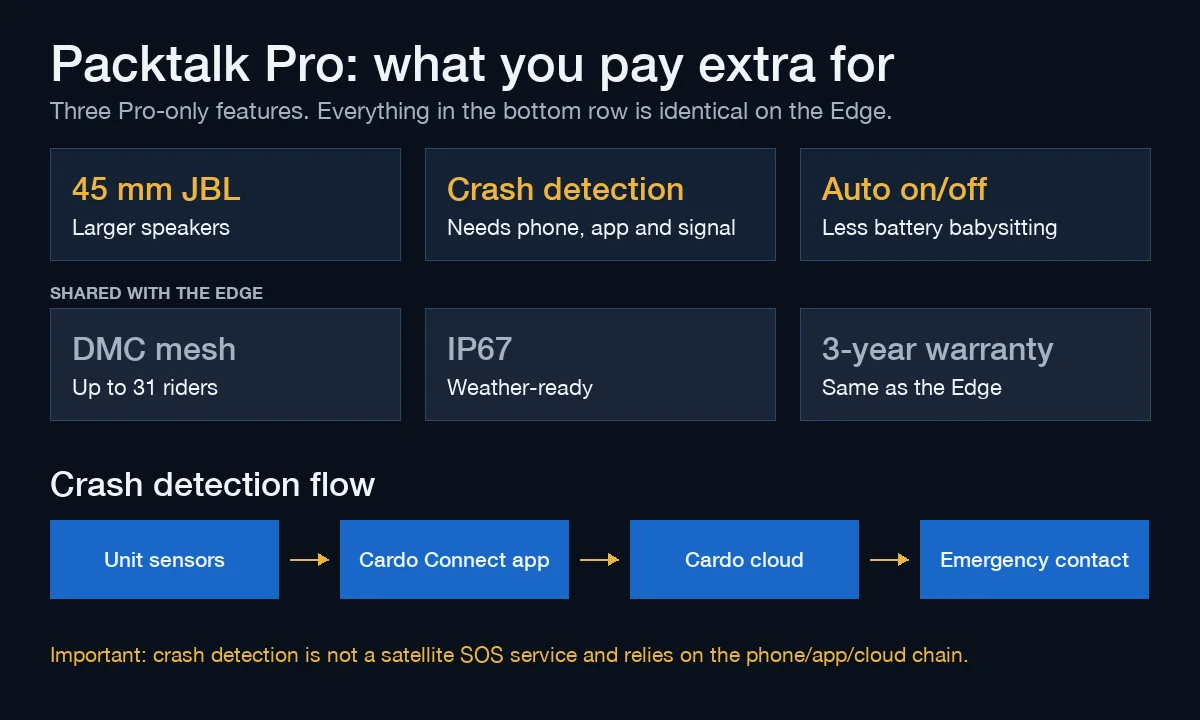
- Crash detection: an IMU-based system that works with the Cardo Connect app and Cardo cloud to notify a pre-set emergency contact after a detected on-road crash.
- 45 mm JBL speakers: larger than the Edge’s 40 mm JBL speakers.
- Auto on/off: the unit powers down when stationary and wakes for the ride.
- Everything else: the core platform is shared with the Edge — Air Mount, DMC mesh, voice control, IP67 design, over-the-air updates, 13-hour battery and the same 3-year warranty.
DMC mesh: still the reason to buy a Packtalk
The strongest reason to buy any current Packtalk is Cardo’s DMC mesh, not the crash sensor or speaker diameter. Mesh lets riders drop out and rejoin without manually repairing a Bluetooth chain, which is the difference between an intercom that works on a real group ride and one that becomes a roadside chore.
Cardo’s current Mesh Boost update supports up to 31 riders on compatible Packtalk units. For most groups that is academic; what matters is self-healing communication and quick reconnection when riders separate at lights or junctions.
45 mm JBL speakers: better, not miraculous
The Pro’s 45 mm JBL speakers are the most obvious hardware upgrade over the Edge. They can deliver more body and headroom, especially when helmet acoustics are good and the speakers sit directly over the ear canal.
Do not expect hi-fi sound at motorway speed. Wind noise, earplugs, helmet shape and speaker placement matter more than the final 5 mm of driver diameter. A badly positioned 45 mm speaker can sound worse than a correctly aligned 40 mm speaker.
If music is a major part of your riding, the Pro has the edge. If intercom speech and GPS prompts are the priority, the Edge is already excellent.
Crash detection: the feature that changes the value equation
Crash detection is the Packtalk Pro feature that can justify the premium for a particular rider. Cardo describes a three-part system using sensors in the unit, the Cardo Connect app and Cardo cloud. When the system identifies an on-road crash, it can notify a pre-set emergency contact.
That also defines the limitation: this is not a self-contained satellite SOS beacon. The system depends on the broader phone/app/cloud chain and crash detection is available only in supported regions. Riders travelling truly off-grid should still think in terms of an inReach-class satellite communicator, not an intercom.
For someone who commutes or tours alone on roads with cellular coverage, though, an automated emergency notification has real value. For a rider always surrounded by six friends, it matters much less.
Auto on/off: a small feature you appreciate every day
Auto on/off sounds trivial until you stop thinking about whether the intercom is still draining its battery on a café table. The Pro uses its motion sensing to sleep when stationary and wake for riding.
It does not transform battery life — Cardo still quotes roughly 13 hours of talk time — but it removes one more piece of device management from the ride.
Air Mount and helmet installation
The magnetic Air Mount remains one of Cardo’s best physical-design decisions. The unit snaps onto the helmet bracket cleanly and can be removed for charging or helmet storage without wrestling with a plastic latch.
Speaker placement deserves more attention than the mount. Centre each 45 mm driver over the ear canal, use the supplied spacers if the helmet pocket is deep, and avoid letting the speaker press directly against the ear. Comfort and perceived volume both depend on this.
Voice control and controls
Natural Voice Operation lets you handle common functions without hunting for buttons in gloves. The physical controls remain useful when voice commands are unreliable in wind or when you simply prefer tactile feedback.
Cardo’s control scheme is mature at this point; the bigger learning curve is usually the app and group setup rather than basic volume or intercom operation.
Battery and charging
Cardo quotes around 13 hours of operation with fast charging support. That covers a normal full riding day. If you are doing very long endurance days, Sena’s newest flagship models can stretch longer, but most riders will charge an intercom every night anyway.
Waterproofing
The Pro carries Cardo’s IP67 design, which is one of the company’s strongest arguments over older Sena flagships that relied on vaguer water-resistance claims. For touring riders who do not stop because it rains, a published ingress rating matters.
Packtalk Pro vs Edge
The Pro is not a fundamentally different intercom from the Edge. It is the Edge platform with a stronger feature bundle: bigger JBL speakers, crash detection and auto on/off. Mesh, waterproofing, battery and the 3-year warranty are the same.
At a $60 list-price gap, the Edge is the default recommendation unless crash detection matters. At the roughly $30 live Amazon gap we saw on October 8, the Pro becomes much easier to recommend.
For the full side-by-side decision, see Cardo Packtalk Edge vs Pro.
Packtalk Pro vs Sena 60S
The Sena 60S is the stronger fit for riders whose group already uses Sena or who value Open Mesh behaviour and longer quoted battery life. The Packtalk Pro counters with Cardo’s Air Mount, IP67 design, crash detection and a very polished DMC experience.
Brand compatibility still matters more than small spec differences. If your regular group is already standardized on Sena, buy Sena. If it is Cardo, buy Cardo. Our Cardo vs Sena guide explains why.
Who should buy the Packtalk Pro?
- Solo riders who value automatic emergency-contact notification.
- Tourers who want Cardo’s best speaker package and waterproof flagship.
- Existing Cardo groups where the rider wants the top model without changing ecosystem.
- Buyers finding the Pro discounted close to Packtalk Edge pricing.
Who should buy something else?
- Packtalk Edge owners whose current unit works well.
- Riders who only need two-way communication with a passenger.
- Sena-group riders who would lose native mesh compatibility by switching.
- Budget buyers who care more about clear speech than premium audio or crash detection.
Is the Cardo Packtalk Pro worth it?
Yes — for the right rider and especially at the right price. It is Cardo’s most complete conventional helmet intercom, and none of its headline features are gimmicks. The issue is that the cheaper Edge already gets the fundamentals so right.
If you ride alone often, crash detection is meaningful, or the live price sits close to the Edge, buy the Pro. If you ride in a group and mainly want excellent mesh communication, save the money and buy the Edge.
Frequently asked questions
Does Packtalk Pro crash detection work without a phone?
The system uses the Packtalk Pro sensors together with the Cardo Connect app and Cardo cloud, so it should not be treated like a standalone satellite emergency beacon.
How many riders can Packtalk Pro connect?
Cardo’s current Mesh Boost platform supports up to 31 riders on compatible Packtalk mesh groups.
Is Packtalk Pro waterproof?
Cardo specifies an IP67 design.
Is Packtalk Pro better than Packtalk Edge?
It has more features, but the Edge provides nearly the same core mesh/intercom experience for less. The Pro is better value when discounted or when crash detection specifically matters to you.
Sources checked
Current specifications and list price were checked against the official Cardo Packtalk Pro page. Amazon pricing was checked on October 8, 2026. For a direct model comparison, see our Packtalk Edge vs Pro research.
This page contains affiliate links. If you buy through them I may earn a commission at no cost to you. See the affiliate disclosure and research policy.