
Last updated October 8, 2026. Prices and availability were checked against current Garmin, RevZilla and Amazon listings. This is a buying comparison, not a duplicate of our full XT3 review.
The Garmin zūmo XT3 is the better motorcycle GPS than the XT2. The real question is whether it is enough better to justify paying more. In October 2026, that question is unusually easy because current retail pricing often puts the newer XT3 at the same price — or even lower — than remaining XT2 stock.
If you are buying new today, the XT3 is the default choice. The XT2 only becomes the smarter buy when you find it at a genuine clearance or used price that creates a meaningful gap. If you already own an XT2 and it works, keep it; the upgrade is real, but not remotely as dramatic as replacing an older zūmo XT.
The short answer
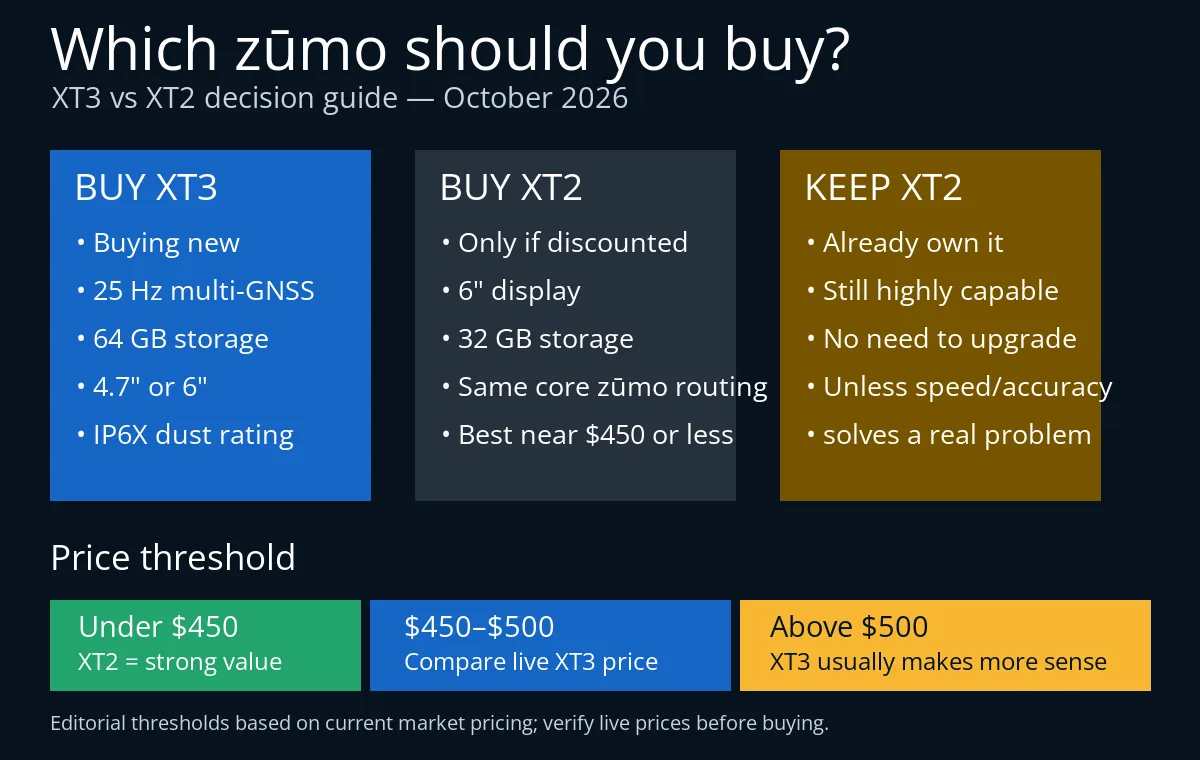
- Buy the XT3 if: you are buying new, you ride in mountains/forest, you want faster route calculation, or you want the 4.7-inch option for a smaller cockpit.
- Buy the XT2 if: you find it roughly $150 or more cheaper than an equivalent XT3 and you do not care about faster positioning, extra storage or the newer hardware.
- Keep your XT2 if: you already own one and it works reliably. The XT3 is better, but an XT2 owner does not gain enough to justify replacing a functioning $600 navigator.
- Buy neither if: you ride mostly paved roads with cellular coverage and mainly want Google Maps, Spotify and messaging on the bike. A CarPlay/Android Auto screen may suit you better for less money.
Affiliate disclosure: This page contains affiliate links. If you buy through them I may earn a commission at no cost to you. How HandlebarHQ earns money.
Garmin zūmo XT3 vs XT2: the differences that matter
- Display: XT2 is 6 inches only. XT3 comes in 6-inch and 4.7-inch versions.
- Positioning: XT2 uses 10 Hz multi-GNSS; XT3 moves to 25 Hz multi-GNSS positioning.
- Storage: XT2 has 32 GB internal storage; XT3 doubles that to 64 GB.
- Performance: XT3 calculates and redraws routes noticeably faster.
- Dust protection: XT3 adds an IP6X dust rating alongside IPX7 water resistance and MIL-STD-810 ruggedness.
- Ride data: XT3 adds live lean-angle and expanded performance metrics.
- Mount compatibility: the XT3 uses the same mount/power-pin architecture as XT2, which makes upgrading easier.
- Maps and core routing: both retain the core zūmo strengths — preloaded street/topographic maps, Adventurous Routing and Tread integration.
Current price reality matters more than MSRP
The XT2 launched at $599.99 and some retailers still list remaining stock at that price. RevZilla currently shows the XT2 at $599.99 even while the newer XT3 appears around the $499.99–$599.99 range depending on size and promotion. Amazon currently lists the 6-inch XT3 at $599.99.
At those prices, buying a new XT2 makes little sense. You are paying the same money for slower hardware, lower-frequency positioning, half the storage and no 4.7-inch option.
Our price threshold: if the XT2 is under about $450, it becomes a serious value option. Around $450–$500, compare the actual XT3 price that day. Above roughly $500, the XT3 usually makes more sense. That is an editorial buying threshold, not a permanent market price — check live stock before ordering.
Positioning: 25 Hz vs 10 Hz
The XT3’s move from 10 Hz to 25 Hz positioning sounds like specification-sheet trivia until you ride in terrain where GPS accuracy actually matters. More frequent position updates make the cursor track the motorcycle more smoothly, which makes the on-screen position update more frequently.
For highway touring on open roads, the XT2 is already good enough. The difference becomes more useful under tree cover, in mountain terrain, in urban canyons and on complicated junctions where the unit needs to know exactly which road you are on.
If your riding regularly includes forest, mountains or off-grid routes, this is the most meaningful technical reason to prefer the XT3.
Speed: the upgrade you notice every day
The XT3 feels more modern because route calculation and map redraws happen faster. That matters when Adventurous Routing recalculates after a missed turn or when a multi-day route contains many shaping points.
The XT2 is not unusably slow. It is simply old enough that you notice the wait. If you are buying fresh hardware in 2026, paying the same money for the faster device is the obvious choice.
Storage: 64 GB vs 32 GB
The XT3 doubles internal storage to 64 GB. Both support expandable storage, so this is not a reason by itself to replace an XT2. It is still useful if you keep a lot of maps, satellite imagery and route data on the device.
Screen size: the XT3 wins by giving you a choice
The XT2 is a 6-inch navigator. The XT3 keeps that size and adds a 4.7-inch version at a lower MSRP.
That smaller model matters more than it sounds. Sport bikes and naked bikes often do not have a clean place for a 6-inch slab without blocking instruments or crowding clip-ons. The 4.7-inch XT3 gives those riders the same core software and hardware generation in a cockpit-friendly package.
Ruggedness: mostly similar, with one useful XT3 addition
Both are proper motorcycle devices built around weather resistance, vibration tolerance and glove use. The XT3 adds a published IP6X dust rating on top of IPX7 water resistance and the MIL-STD-810 drop standard.
For road touring, that is not transformative. For ADV riders living in gravel dust, it is a worthwhile hardware improvement.
Maps and routing: more alike than different
Do not buy the XT3 expecting a fundamentally different navigation philosophy. Both devices use Garmin’s core motorcycle routing approach, preloaded maps, Adventurous Routing and Tread app integration.
That is why the XT2 remains such a good clearance buy. Garmin improved the hardware generation without making the previous one obsolete.
Lean angle and Performance Package
The XT3 adds live lean angle, G-force, maximum speed and expanded ride summaries. Garmin also offers its optional Performance Package for track and drag-racing features.
Those are nice additions, not reasons most touring riders should spend hundreds of dollars. If you care about navigation first, processor speed and positioning accuracy matter far more.
Do XT2 mounts work with XT3?
Garmin confirms the XT3 navigator can use an XT2 motorcycle mount and wiring harness, and the XT2 navigator can use the XT3 mount. The XT2 and XT3 wiring harnesses are the same. However, Garmin says the separate handlebar mount kits and motorcycle brackets are configured differently and should not be mixed and matched.
If you already have multiple bikes wired for an XT2, that compatibility removes one of the usual reasons not to upgrade. It still does not make the upgrade good value if your XT2 is working perfectly.
Should an XT2 owner upgrade to XT3?
Usually no. The XT3 is the better unit, but the XT2 already has the big things that make a zūmo worth owning: rugged hardware, sunlight-readable screen, offline maps, motorcycle routing and Tread integration.
Upgrade if one of the XT3 changes solves a specific problem for you — GPS drift under tree cover, frustrating route-calculation speed, tight cockpit space, or a damaged/aging XT2. Otherwise, keep the XT2 and put the money toward fuel, tyres or another bike accessory.
Should an original zūmo XT owner upgrade?
The case is stronger. Moving from the original XT to XT3 gives you a newer processor generation, expanded ride/navigation features, newer positioning hardware and the option of a smaller screen.
If your original XT is still doing everything you need, you can still keep it. But this is a more meaningful generational jump than XT2 to XT3.
XT3 vs XT2 for touring
Both are excellent touring navigators. The XT3 is the better purchase for a new buyer because it calculates faster and gives you newer hardware for similar money. The XT2 becomes attractive only when discounted enough to fund something else you need for the trip.
XT3 vs XT2 for ADV and off-road riding
The XT3 gets the edge because of its faster 25 Hz positioning and added IP6X dust rating. Garmin’s routing ecosystem still has its own learning curve, and riders focused heavily on GPX/off-road workflows may also want to compare purpose-built Android navigation devices.
XT3 vs XT2 vs a CarPlay screen
A Garmin zūmo makes sense when navigation must work without cellular coverage, when you plan complex routes, or when you want a completely independent device. A CarPlay/Android Auto screen makes more sense for road riders who mainly want phone apps on a weatherproof display.
Our CarPlay screen vs dedicated GPS guide covers that category decision in detail.
Who should buy the XT3?
- New buyers who want the current-generation zūmo.
- Touring and ADV riders who frequently lose cell coverage.
- Riders in mountains or forest who value stronger positioning.
- Sport/naked-bike riders who need the 4.7-inch version.
- XT2 owners whose current unit is failing and who can reuse their existing installation.
Who should buy the XT2?
- Bargain hunters who find legitimate new/clearance stock around $450 or below.
- Used buyers who can verify the unit, mount and battery are in good condition.
- Riders who want zūmo routing but do not care about the latest positioning hardware.
- Anyone for whom the price difference is large enough to matter more than faster performance.
Final verdict
The Garmin zūmo XT3 is the one to buy new. In October 2026, current pricing often leaves too little — or no — discount on remaining XT2 stock to justify choosing the older navigator.
The XT2 is still an excellent motorcycle GPS. It just needs the right price. Under roughly $450, it becomes a compelling value buy. At similar prices, take the XT3 every time.
If you already own an XT2, keep it unless one of the XT3’s specific upgrades solves a real problem. For the full ownership view, see our Garmin zūmo XT3 review, or compare the wider field in Best Motorcycle GPS Units.
Frequently asked questions
Is the Garmin zūmo XT3 worth it over the XT2?
For a new buyer at similar prices, yes. For an existing XT2 owner, usually no. The upgrade is evolutionary rather than transformative.
Is the XT2 discontinued?
The XT2 is now the previous-generation model and some retailers describe it as discontinued or replaced by the XT3, but remaining stock is still being sold.
Does the XT3 use the same mount as the XT2?
Yes. Garmin says XT2 and XT3 navigators are backwards-compatible with each other’s powered device mounts and use the same wiring harness, although the separate handlebar/bracket hardware should not be mixed between generations.
Which is better for off-road riding?
The XT3 has the technical advantage because of newer positioning hardware and the added dust rating, although both use Garmin’s broader map/Tread ecosystem.
Sources checked
XT3 launch features, screen sizes and MSRP were checked against Garmin’s February 2026 announcement. The 25 Hz multi-GNSS, 64 GB storage and IP6X dust-rating differences were checked against Garmin’s XT3/XT2 comparison, while mount compatibility was checked against Garmin Support. XT2 current status and pricing were cross-checked against RevZilla’s XT2 listing.
This page contains affiliate links. If you buy through them I may earn a commission at no cost to you. See the affiliate disclosure and research policy.